Prayer Brings Peace
One of the things about modern families that concerns me is the great increase in PESSIMISM and ANXIETY among parents. Good parents are so worried about life that they tend to over protect their kids and anxiously hover over them. This is much more dangerous than allowing kids to be free.
During the Black Plague in Europe some 25 million people died. This amounts to about one third of the total population of that continent. No wonder they developed a lot of fears and anxiety that came out in their religious practice. Perhaps the worst prayer ever written came from worried parents and priests.
Now I lay me down to sleep
I pray the Lord my soul will keep
If I should DIE before I wake
I pray the Lord my soul to take
Is it any wonder that children would have nightmares? We are still teaching this awful poem to our children. I have written a new prayer for parents.
A New Prayer For Sleeping
Now I lay me down to sleep
I thank the Lord my soul will keep
No fear of night, He will provide-
His angels near, my sleeping side
At morning's dawn, I will awake,
To live again for Jesus' sake
He gives me strength, the whole night rest
Enough each day to give my best
(C) Gary Sweeten
Please teach this prayer of faith and peace to your children
Tuesday, November 22, 2005
Bible Belt states are the most generous givers to charity
Posted by Mark Tapscott on November 22, 2005 - 13:35.
It may not get much play in the MSM, but the Catalogue for Philanthropy's latest National Generosity Index finds a clear majority of the most generous states are in the Bible Belt where evangelical Christianity is strongest and household income is lowest.
The least generous states are mostly in areas in which evangelicals are least common, but household incomes are highest.
Here are the Top 10, including six that are the heart of the Bible Belt and two more that are strongly influenced by it. The dollar figure in parenthesis is the U.S. Census Bureau's latest available (2004) household income figure, followed by the state's national ranking for that factor. The B indicates Bush carried in 2004. K indicates Kerry carried in 2004:
1. Mississippi ($31,642)(50)(B)
2. Arkansas ($32,983)(49)(B)
3. South Dakota ($38,472)(42)(B)
4. Oklahoma ($35,357)(45)(B)
5. Tennessee ($38,794)(41)(B)
6. Alabama ($36,709)(43)(B)
7. Louisiana ($35,110)(48)(B)
8. Utah ($47,074)(17)(B)
9. South Carolina ($39,837)(38)(B)
10. West Virginia ($31,504)(51)(B)
Now take a look at the second 10, which includes another six that are either clearly part of the Bible Belt or strongly influenced by it:
11. Idaho ($39,934)(37)(B)
12. Texas ($41,759)(31)(B)
13. Nebraska ($41,657)(32)(B)
14. North Dakota ($39,447)(39)(B)
15. Wyoming ($44,275))(23)(B)
16. North Carolina ($39,428)(40)(B)
17. Kansas ($41,638)(33)(B)
18. Florida ($41,236)(36)
19. Georgia ($43,037)(24)(B)
20. Missouri ($41,473)(34)(B)
Now, scan the Bottom 10 least generous states, which includes eight Yankee states where Southern Baptists are as scarce as common sense at a Michael Moore fan club meeting:
41. Michigan ($44,905)(21)(K)
42. Hawaii ($53,554)(7)(K)
43. Colorado ($48,198)(14)(B)
44. Minnesota ($50,860)(10)(K)
45. Connecticut ($60,528)(2)(K)
46. Wisconsin ($45,315)(20)(K)
47. Rhode Island ($48,722)(13)(K)
48. New Jersey ($61,359)(1)(K)
49. Massachusetts ($55,658)(5)(K)
50. New Hampshire ($55,580)(6)(K)
The states with the lowest household income are in the Bible Belt and that is where people are the most generous givers to charitable causes. Every one of the Top 10 most generous was carried by President Bush in the 2004 presidential election.
The most secular states with the highest household incomes are the least generous. Nine of the 10 least generous were carried by Sen. John Kerry, the Democratic presidential nominee.
Cross-posted at Tapscott's Copy Desk.
The people who want to eliminate God and charitable ideas from schools and daily life need to seriously consider the consequences. I assume that the Left Wing prefers compassion to harsh uncaring but I am not so sure when I see this data.
Posted by Mark Tapscott on November 22, 2005 - 13:35.
It may not get much play in the MSM, but the Catalogue for Philanthropy's latest National Generosity Index finds a clear majority of the most generous states are in the Bible Belt where evangelical Christianity is strongest and household income is lowest.
The least generous states are mostly in areas in which evangelicals are least common, but household incomes are highest.
Here are the Top 10, including six that are the heart of the Bible Belt and two more that are strongly influenced by it. The dollar figure in parenthesis is the U.S. Census Bureau's latest available (2004) household income figure, followed by the state's national ranking for that factor. The B indicates Bush carried in 2004. K indicates Kerry carried in 2004:
1. Mississippi ($31,642)(50)(B)
2. Arkansas ($32,983)(49)(B)
3. South Dakota ($38,472)(42)(B)
4. Oklahoma ($35,357)(45)(B)
5. Tennessee ($38,794)(41)(B)
6. Alabama ($36,709)(43)(B)
7. Louisiana ($35,110)(48)(B)
8. Utah ($47,074)(17)(B)
9. South Carolina ($39,837)(38)(B)
10. West Virginia ($31,504)(51)(B)
Now take a look at the second 10, which includes another six that are either clearly part of the Bible Belt or strongly influenced by it:
11. Idaho ($39,934)(37)(B)
12. Texas ($41,759)(31)(B)
13. Nebraska ($41,657)(32)(B)
14. North Dakota ($39,447)(39)(B)
15. Wyoming ($44,275))(23)(B)
16. North Carolina ($39,428)(40)(B)
17. Kansas ($41,638)(33)(B)
18. Florida ($41,236)(36)
19. Georgia ($43,037)(24)(B)
20. Missouri ($41,473)(34)(B)
Now, scan the Bottom 10 least generous states, which includes eight Yankee states where Southern Baptists are as scarce as common sense at a Michael Moore fan club meeting:
41. Michigan ($44,905)(21)(K)
42. Hawaii ($53,554)(7)(K)
43. Colorado ($48,198)(14)(B)
44. Minnesota ($50,860)(10)(K)
45. Connecticut ($60,528)(2)(K)
46. Wisconsin ($45,315)(20)(K)
47. Rhode Island ($48,722)(13)(K)
48. New Jersey ($61,359)(1)(K)
49. Massachusetts ($55,658)(5)(K)
50. New Hampshire ($55,580)(6)(K)
The states with the lowest household income are in the Bible Belt and that is where people are the most generous givers to charitable causes. Every one of the Top 10 most generous was carried by President Bush in the 2004 presidential election.
The most secular states with the highest household incomes are the least generous. Nine of the 10 least generous were carried by Sen. John Kerry, the Democratic presidential nominee.
Cross-posted at Tapscott's Copy Desk.
The people who want to eliminate God and charitable ideas from schools and daily life need to seriously consider the consequences. I assume that the Left Wing prefers compassion to harsh uncaring but I am not so sure when I see this data.
Friday, November 18, 2005
Life Way Ministries 2005 Fund Drive
For all those of you who did not receive my fund raising letter, here it is.
Dear Supporting Friends,
This has been a year of continual crises and catastrophic problems. A record shattering tsunami, multiple tornadoes, wars and rumors of wars along with so many hurricanes that we ran out of names has brought despair and exhaustion. These tragedies pulled our heartstrings and pressed us to our knees. It even has Jay Leno suggesting that this is not a good time to take God out of the Pledge of Allegiance.
It has also been a blessed time for ministries of compassion and healing. God’s people have with love, money and manpower. I am proud to be a Christian. Even some atheists have noticed and admitted that for some strange reason Christians show more compassion and do more hard work during a crisis than do secular humanists.
In the midst of all this we at Life Way Ministries have been quietly continuing our call of multiplying ministers. We equip believers with knowledge of God’s word along with the practical skills to live it out. Our Asian ministries are at a point where they are less dependent upon US support. Our Asian team is taking God’s word directly to churches around the Pacific Rim.
Lifeways Russia is prospering greatly. The dramatic increase in trained volunteers allows Galina and her team to develop equipping centers around the former USSR. My recent trip filled me with thanksgiving and awe to God for His work among this devastated nation.
Now for the Fund Drive. As Founder, President, COO, CFO, CEO and Chairman I had a meeting with the entire staff of Life Way Ministries to discuss money. I have been invited to a dozen dinners, golf tournaments, outings, barbeques, banquets, speakers, building promotions, fishing tournaments, flights to Africa, special events, radio funders and hard sell concerts. I asked what kind of big event we should try to pull off to get our friends to financially support us.
I asked my Secretary, me, to call the Director of Development, me, to set up a meeting with the Big Events Coordinator, me, and the Little Events Director, me, as well as the Newsletter Publisher, me, the Public Relations V.P., me, and ask the Golf Outing expert, me, and the Banquet Planner, me, who contacted the Chef, me, about getting a famous and expensive International Missionary Speaker, me, and a Big Name Entertainment Coordinator, me, along with the Choir Director, me, and the Band Master, me, to plan a big meal at an expensive hotel with me cooking and have an emotional slide show by me before a talk was given by me to pressure friends into giving. With a staff this big we need a lot of cash to keep us going.
By the time the group was gathered its members, me, me and me, were so exhausted that we had to call for someone with gifts of healing, me, to pray for strength. Here was our decision: If you require a meal, a golf game, a slide show, a famous speaker with a talk about Russia, Asia, Islam and world evangelism or a concert to get you to make a donation to Life Way Ministries, call me. I will have you over to lunch, take you to Sharon Woods for golf, sing to you, play a tape of your favorite preacher, show you all of my slides and photos from the past 20 years of international ministry and pray with you about your needs. I will share the startling stats about leaders being trained, people delivered from addictions and families set free from sexual brokenness and the thousands of lay persons and churches we are influencing.
Your support goes directly into missions and leadership development here and around the world. It goes to develop leaders in Russia, Ukraine, Singapore, Scandinavia and the USA. No local ministry has done more to fight pornography or heal Christians of addictions. Nobody has done more to develop and support Christian unity in Greater Cincinnati. We are excited about the future as we expand our influence and reach. Come along with us and enjoy God’s blessings.
We need you to keep Life Way Ministries going.
Thanks,
Gary Sweeten
Life Way Ministries, Inc
11161 Kenwood Rd
Cincinnati, Ohio 45242
A non Profit, tax-deductible charity
For all those of you who did not receive my fund raising letter, here it is.
Dear Supporting Friends,
This has been a year of continual crises and catastrophic problems. A record shattering tsunami, multiple tornadoes, wars and rumors of wars along with so many hurricanes that we ran out of names has brought despair and exhaustion. These tragedies pulled our heartstrings and pressed us to our knees. It even has Jay Leno suggesting that this is not a good time to take God out of the Pledge of Allegiance.
It has also been a blessed time for ministries of compassion and healing. God’s people have with love, money and manpower. I am proud to be a Christian. Even some atheists have noticed and admitted that for some strange reason Christians show more compassion and do more hard work during a crisis than do secular humanists.
In the midst of all this we at Life Way Ministries have been quietly continuing our call of multiplying ministers. We equip believers with knowledge of God’s word along with the practical skills to live it out. Our Asian ministries are at a point where they are less dependent upon US support. Our Asian team is taking God’s word directly to churches around the Pacific Rim.
Lifeways Russia is prospering greatly. The dramatic increase in trained volunteers allows Galina and her team to develop equipping centers around the former USSR. My recent trip filled me with thanksgiving and awe to God for His work among this devastated nation.
Now for the Fund Drive. As Founder, President, COO, CFO, CEO and Chairman I had a meeting with the entire staff of Life Way Ministries to discuss money. I have been invited to a dozen dinners, golf tournaments, outings, barbeques, banquets, speakers, building promotions, fishing tournaments, flights to Africa, special events, radio funders and hard sell concerts. I asked what kind of big event we should try to pull off to get our friends to financially support us.
I asked my Secretary, me, to call the Director of Development, me, to set up a meeting with the Big Events Coordinator, me, and the Little Events Director, me, as well as the Newsletter Publisher, me, the Public Relations V.P., me, and ask the Golf Outing expert, me, and the Banquet Planner, me, who contacted the Chef, me, about getting a famous and expensive International Missionary Speaker, me, and a Big Name Entertainment Coordinator, me, along with the Choir Director, me, and the Band Master, me, to plan a big meal at an expensive hotel with me cooking and have an emotional slide show by me before a talk was given by me to pressure friends into giving. With a staff this big we need a lot of cash to keep us going.
By the time the group was gathered its members, me, me and me, were so exhausted that we had to call for someone with gifts of healing, me, to pray for strength. Here was our decision: If you require a meal, a golf game, a slide show, a famous speaker with a talk about Russia, Asia, Islam and world evangelism or a concert to get you to make a donation to Life Way Ministries, call me. I will have you over to lunch, take you to Sharon Woods for golf, sing to you, play a tape of your favorite preacher, show you all of my slides and photos from the past 20 years of international ministry and pray with you about your needs. I will share the startling stats about leaders being trained, people delivered from addictions and families set free from sexual brokenness and the thousands of lay persons and churches we are influencing.
Your support goes directly into missions and leadership development here and around the world. It goes to develop leaders in Russia, Ukraine, Singapore, Scandinavia and the USA. No local ministry has done more to fight pornography or heal Christians of addictions. Nobody has done more to develop and support Christian unity in Greater Cincinnati. We are excited about the future as we expand our influence and reach. Come along with us and enjoy God’s blessings.
We need you to keep Life Way Ministries going.
Thanks,
Gary Sweeten
Life Way Ministries, Inc
11161 Kenwood Rd
Cincinnati, Ohio 45242
A non Profit, tax-deductible charity
Wednesday, November 16, 2005
Teach Morality if You Want Good Morals in Your Kids
Morals and values -- not just AIDS and pregnancy -- are important parts of the discussion about teen sex, a new survey and report suggest.
The survey, commissioned by the National Campaign to Prevent Teen Pregnancy, found that teens say morals, values and religion play a major role in their decisions about sex.
The campaign also released a review of the research on religion and teen sex, which finds more religious teens are more likely to wait until they are older to have sex. But the research also suggests that once religious teens do have sex, they are less likely to use contraception.
The authors conclude that none of this research is strong enough to recommend any particular approach. Still, the campaign hopes its report will expand the discussion of how to further reduce teen pregnancy rates, which have fallen dramatically over the last decade.
"Preventing teen pregnancy is as much about moral and religious values as it is about public health," said the report being released Tuesday. "Teens, like adults, make decisions about their sexual behavior based in part on their values about what is right and wrong, what is proper and what is not."
The survey of 502 teens, conducted September 5-9, also found that half of teens said their parents were most influential in decisions about sex, three times the number who cited friends.
In 1997, the most recent year for which pregnancy data are available, about 9.4 percent of all girls ages 15 to 19 became pregnant. Among girls ages 15 to 17, some 6.4 percent were pregnant in 1997, down 21 percent since the peak in 1990.
The survey, one of several sponsored by the campaign, found that 39 percent of teen-agers said that "morals, values and/or religious beliefs" were the most important factor affecting their decision about whether to have sex. That's more than double the second most popular answer, concern about sexually transmitted diseases, which was the most important factor for 17 percent of respondents.
Even among those teens who say they rarely or never attend religious services, 26 percent said morals, values and/or religion was the most important factor.
The review of research on teen sex and religion examined 50 studies and concluded the research is "surprisingly weak." But it did spot trends:
-- Teens who attend services frequently are less likely to have permissive attitudes about sex. Those who attend services tend to wait longer to have sex, at least among white boys and all girls.
-- More religious teens have more conservative attitudes about sex, but these attitudes are only moderately related to their future behavior.
-- Catholic and fundamentalist Protestant girls are particularly likely to wait to have sex, but they are also less likely to use contraception once they do so.
The National Campaign to Prevent Teen Pregnancy, an independent group founded in 1996, sponsors research about what programs work and offers advice to communities that are working to reduce their pregnancy rates.
Copyright 2001 The Associated Press.
Morals and values -- not just AIDS and pregnancy -- are important parts of the discussion about teen sex, a new survey and report suggest.
The survey, commissioned by the National Campaign to Prevent Teen Pregnancy, found that teens say morals, values and religion play a major role in their decisions about sex.
The campaign also released a review of the research on religion and teen sex, which finds more religious teens are more likely to wait until they are older to have sex. But the research also suggests that once religious teens do have sex, they are less likely to use contraception.
The authors conclude that none of this research is strong enough to recommend any particular approach. Still, the campaign hopes its report will expand the discussion of how to further reduce teen pregnancy rates, which have fallen dramatically over the last decade.
"Preventing teen pregnancy is as much about moral and religious values as it is about public health," said the report being released Tuesday. "Teens, like adults, make decisions about their sexual behavior based in part on their values about what is right and wrong, what is proper and what is not."
The survey of 502 teens, conducted September 5-9, also found that half of teens said their parents were most influential in decisions about sex, three times the number who cited friends.
In 1997, the most recent year for which pregnancy data are available, about 9.4 percent of all girls ages 15 to 19 became pregnant. Among girls ages 15 to 17, some 6.4 percent were pregnant in 1997, down 21 percent since the peak in 1990.
The survey, one of several sponsored by the campaign, found that 39 percent of teen-agers said that "morals, values and/or religious beliefs" were the most important factor affecting their decision about whether to have sex. That's more than double the second most popular answer, concern about sexually transmitted diseases, which was the most important factor for 17 percent of respondents.
Even among those teens who say they rarely or never attend religious services, 26 percent said morals, values and/or religion was the most important factor.
The review of research on teen sex and religion examined 50 studies and concluded the research is "surprisingly weak." But it did spot trends:
-- Teens who attend services frequently are less likely to have permissive attitudes about sex. Those who attend services tend to wait longer to have sex, at least among white boys and all girls.
-- More religious teens have more conservative attitudes about sex, but these attitudes are only moderately related to their future behavior.
-- Catholic and fundamentalist Protestant girls are particularly likely to wait to have sex, but they are also less likely to use contraception once they do so.
The National Campaign to Prevent Teen Pregnancy, an independent group founded in 1996, sponsors research about what programs work and offers advice to communities that are working to reduce their pregnancy rates.
Copyright 2001 The Associated Press.
Being a "Good" Parents may make your child use drugs!
It true! Being a good parent may make your kid more likely to use drugs, drink alcohol, or smoke--that is, if you (the parent) use drugs, drink alcohol, or smoke.
Researchers Andrews, Hops, and Duncan found that kids who have good relationships with their parents are more likely to use drugs if those parents use drugs themselves. In contrast, kids with poor relationships with their parents are less likely to emulated the parent's bad behavior.
What does it all mean? If you don't want your child doing drugs, drinking, or smoking then you must:
(a) continue to use yourself but make them dislike you; or
(b) stop using and do whatever you can to promote a good relationship with your kids!
Andrews, J., Hops, H., & Duncan, S. Journal of Family Therapy. Reported in Family
It true! Being a good parent may make your kid more likely to use drugs, drink alcohol, or smoke--that is, if you (the parent) use drugs, drink alcohol, or smoke.
Researchers Andrews, Hops, and Duncan found that kids who have good relationships with their parents are more likely to use drugs if those parents use drugs themselves. In contrast, kids with poor relationships with their parents are less likely to emulated the parent's bad behavior.
What does it all mean? If you don't want your child doing drugs, drinking, or smoking then you must:
(a) continue to use yourself but make them dislike you; or
(b) stop using and do whatever you can to promote a good relationship with your kids!
Andrews, J., Hops, H., & Duncan, S. Journal of Family Therapy. Reported in Family
Tuesday, November 15, 2005
In Honor of Peter Drucker
Mr. Drucker died last week at age 95. He spent his life trying to help people set up and manage organizations that valued people and served humanity. He once met with a group of pastors and para-church leaders and told them that because they were so important to society that he would give his time to them. Rather than selling his day for $10,000.00 to 20,000.00 per day to GE or GM he volunteered to coach these men and women free.
"Whenever you see a successful business, someone once made a courageous decision." Peter Drucker
It has been my experience that few pastors and church workers really esteem the time God has given them. Rarely do I meet a Christian leader who thinks what he is doing is important.
Why do I think this is true? Because they waste so much of their time and they do almost nothing to increase their efficiency and effectiveness. They often preach too long and run meetings too long. If there are 100 people in a meeting that runs 15 minutes over time 25 human hours are wasted.
I am a Church Consultant and a Leader Coach. I teach leaders how to run a more effective life and a more efficient ministry. It is not difficult to stop wasting God's precious time and your precious energy. All it takes is a courageous and teachable spirit.
Mr. Drucker died last week at age 95. He spent his life trying to help people set up and manage organizations that valued people and served humanity. He once met with a group of pastors and para-church leaders and told them that because they were so important to society that he would give his time to them. Rather than selling his day for $10,000.00 to 20,000.00 per day to GE or GM he volunteered to coach these men and women free.
"Whenever you see a successful business, someone once made a courageous decision." Peter Drucker
It has been my experience that few pastors and church workers really esteem the time God has given them. Rarely do I meet a Christian leader who thinks what he is doing is important.
Why do I think this is true? Because they waste so much of their time and they do almost nothing to increase their efficiency and effectiveness. They often preach too long and run meetings too long. If there are 100 people in a meeting that runs 15 minutes over time 25 human hours are wasted.
I am a Church Consultant and a Leader Coach. I teach leaders how to run a more effective life and a more efficient ministry. It is not difficult to stop wasting God's precious time and your precious energy. All it takes is a courageous and teachable spirit.
Scary Marketing from Iran
The recent suicide bombings in Lebanon with one of the killers a woman who failed shows us just how different we Christians are from Muslims. Look at this video for kids to see for yourself how they are recruiting young killers.
Clip# 906, found at http://www.memritv.org/search.asp is a very effective
tool for recruiting Iranian children to become suicide bombers.
The following was written by Rev. Bob Vincent.
When I had our Muslim Imam give a lecture to my class last year, I had
planted a question with a student: "In Islam how can I know for sure that I
am going to heaven?"
The Imam's answer was: "You cannot know. But neither can you know this in
Christianity. No one can know if he has done enough good in order to know
that he is going to heaven."
The next day I pointed out to my high school seniors that both Muslims and
Christians can know that they are going to heaven. There is one infallible
way to know, according to the teachings of both faiths. In Christianity,
everyone who has turned from his sins and put his trust in the Lord Jesus
Christ can know that he is going to heaven. In Islam, everyone who dies in
battle, defending Islam is assured of heaven:
"When you meet the unbelievers, smite their necks, then, when you have made wide slaughter among them, tie fast the bonds; then set them free, either by grace or ransom, till the war lays down its loads. So it shall be; and if God had willed, He would have avenged Himself upon them; but that He may try some of you by means of others. And those who are slain in the way of God,
He will not send their works astray. He will guide them, and dispose their minds aright, and He will admit them to Paradise, that He has made known to
them." (Koran XLVII:4-8)
"So let them fight in the way of God who sell the present life for the world to come; and whosoever fights in the way of God and is slain, or conquers, We shall bring him a mighty wage." (Koran IV:75)
"God has bought from the believers their selves and their possessions against the gift of Paradise; they fight in the way of God; they kill, and are killed; that is a promise binding upon God in the Torah, and the Gospel, and the Koran; and who fulfills his covenant truer than God?" (Koran IX:110)
"Surely the godfearing shall be in a station secure among gardens and fountains, robed in silk and brocade, set face to face. Even so; and We shall espouse them to wide-eyed houris,* therein calling for every fruit, secure." (Koran XLIV:52)
To retreat before the enemy in a Jihad, unless it was for tactical reasons, was an absolute guarantee of instantly going to a burning hell: "O believers, when you encounter the unbelievers marching to battle, turn not your backs to them. Whoso turns his back that day to them, unless
withdrawing to fight again or removing to join another host, he is laden with the burden of God's anger, and his refuge is Gehenna—an evil homecoming!" (Koran VIII:15)
*(Houri: a black-eyed woman 1. any of the beautiful nymphs of the Moslem Paradise, among the rewards of faithful Moslems 2. a seductively beautiful woman)
Bob
bob@rbvincent.com
www.rbvincent.com
The recent suicide bombings in Lebanon with one of the killers a woman who failed shows us just how different we Christians are from Muslims. Look at this video for kids to see for yourself how they are recruiting young killers.
Clip# 906, found at http://www.memritv.org/search.asp is a very effective
tool for recruiting Iranian children to become suicide bombers.
The following was written by Rev. Bob Vincent.
When I had our Muslim Imam give a lecture to my class last year, I had
planted a question with a student: "In Islam how can I know for sure that I
am going to heaven?"
The Imam's answer was: "You cannot know. But neither can you know this in
Christianity. No one can know if he has done enough good in order to know
that he is going to heaven."
The next day I pointed out to my high school seniors that both Muslims and
Christians can know that they are going to heaven. There is one infallible
way to know, according to the teachings of both faiths. In Christianity,
everyone who has turned from his sins and put his trust in the Lord Jesus
Christ can know that he is going to heaven. In Islam, everyone who dies in
battle, defending Islam is assured of heaven:
"When you meet the unbelievers, smite their necks, then, when you have made wide slaughter among them, tie fast the bonds; then set them free, either by grace or ransom, till the war lays down its loads. So it shall be; and if God had willed, He would have avenged Himself upon them; but that He may try some of you by means of others. And those who are slain in the way of God,
He will not send their works astray. He will guide them, and dispose their minds aright, and He will admit them to Paradise, that He has made known to
them." (Koran XLVII:4-8)
"So let them fight in the way of God who sell the present life for the world to come; and whosoever fights in the way of God and is slain, or conquers, We shall bring him a mighty wage." (Koran IV:75)
"God has bought from the believers their selves and their possessions against the gift of Paradise; they fight in the way of God; they kill, and are killed; that is a promise binding upon God in the Torah, and the Gospel, and the Koran; and who fulfills his covenant truer than God?" (Koran IX:110)
"Surely the godfearing shall be in a station secure among gardens and fountains, robed in silk and brocade, set face to face. Even so; and We shall espouse them to wide-eyed houris,* therein calling for every fruit, secure." (Koran XLIV:52)
To retreat before the enemy in a Jihad, unless it was for tactical reasons, was an absolute guarantee of instantly going to a burning hell: "O believers, when you encounter the unbelievers marching to battle, turn not your backs to them. Whoso turns his back that day to them, unless
withdrawing to fight again or removing to join another host, he is laden with the burden of God's anger, and his refuge is Gehenna—an evil homecoming!" (Koran VIII:15)
*(Houri: a black-eyed woman 1. any of the beautiful nymphs of the Moslem Paradise, among the rewards of faithful Moslems 2. a seductively beautiful woman)
Bob
bob@rbvincent.com
www.rbvincent.com
Monday, November 14, 2005
What is the Goal of A Church Leader?
The topic of leadership is very popular and it seems to me that most folks are pretty confused about what good church leaders do.
Who do good leaders lead?
Who are the followers?
Why are leaders needed?
A bad definition: Leaders competently lead followers toward a goal. One cannot be a leader is no one is following.
A good definition: Leaders facilitate the development of processes and systems in such a way that many leaders are developed.
For example, a small group of ten persons ought to have ten leaders, none of whom is doing the same things but all of whom are using their gifts, talents and call.
Imagine that such a group has one member that calls them together, another that organizes the fellowship, another who leads worship, another the word, another ministry, another outreach, another prayer, etc. This is how every person leads.
Try this exercise some time with your group. Get into groups of three and answer this question: "What organ or member leads the human body?"
The topic of leadership is very popular and it seems to me that most folks are pretty confused about what good church leaders do.
Who do good leaders lead?
Who are the followers?
Why are leaders needed?
A bad definition: Leaders competently lead followers toward a goal. One cannot be a leader is no one is following.
A good definition: Leaders facilitate the development of processes and systems in such a way that many leaders are developed.
For example, a small group of ten persons ought to have ten leaders, none of whom is doing the same things but all of whom are using their gifts, talents and call.
Imagine that such a group has one member that calls them together, another that organizes the fellowship, another who leads worship, another the word, another ministry, another outreach, another prayer, etc. This is how every person leads.
Try this exercise some time with your group. Get into groups of three and answer this question: "What organ or member leads the human body?"
Sunday, November 13, 2005
SCARY" STATISTICS
Journal of the American Medical Association
Several surveys conducted during the past decade suggest that the prevalence of depression among college students is growing, and that it eclipses the rate in the general public. Richard Kadison, MD, chief of the Mental Health Service at Harvard's University Health Services in Boston, Mass, offered what he called some "scary" statistics.
Citing a 2000 survey by the American College Health Association, Kadison said that within the last school year, 61% of college students reported feeling hopeless, 45% said they felt so depressed they could barely function, and 9% felt suicidal. The National Mental Health Association's College Student and Depression Pilot Initiative lists suicide as the second leading cause of death among college students.
Another survey by researchers at Kansas State University in Manhattan has shown that from 1988-1992 to 1996-2001, the proportion of students who came to its counseling center with depression increased from 21% to 41%.
A 1999 survey by researchers at the University of California, Los Angeles, reported that 30% of college freshman felt overwhelmed by the transition to campus life, compared with only 16% in 1985. The US Surgeon General's report on mental health in 1999 indicated that about 20% of US adults will experience depression at some time in their lives.
What can we do?
Work on preparing kids for college. Teach them skills in communication, problem solving and conflict management. Also, how to Renew their minds with the Bible.
In preparation for the conference, Todd Sevig, PhD, director of the University of Michigan Counseling and Psychological Services, examined 1992-2002 utilization data from counseling centers at the 11 universities that comprise the Big Ten Conference. "There has been roughly a 42% increase in the number of students seen at these counseling centers," he said.
Massachusetts Institute of Technology (MIT), in Boston, also has recorded an increase in the number of students seeking counseling. Kristine Girard, MD, chief of Mental Health Services, said that from 1995 to 2000, the proportion of the student body seeking counseling increased from 8% to 12%. "That figure continues to rise at about 1% per year, and it taxes our services," said Girard.
Journal of the American Medical Association
Several surveys conducted during the past decade suggest that the prevalence of depression among college students is growing, and that it eclipses the rate in the general public. Richard Kadison, MD, chief of the Mental Health Service at Harvard's University Health Services in Boston, Mass, offered what he called some "scary" statistics.
Citing a 2000 survey by the American College Health Association, Kadison said that within the last school year, 61% of college students reported feeling hopeless, 45% said they felt so depressed they could barely function, and 9% felt suicidal. The National Mental Health Association's College Student and Depression Pilot Initiative lists suicide as the second leading cause of death among college students.
Another survey by researchers at Kansas State University in Manhattan has shown that from 1988-1992 to 1996-2001, the proportion of students who came to its counseling center with depression increased from 21% to 41%.
A 1999 survey by researchers at the University of California, Los Angeles, reported that 30% of college freshman felt overwhelmed by the transition to campus life, compared with only 16% in 1985. The US Surgeon General's report on mental health in 1999 indicated that about 20% of US adults will experience depression at some time in their lives.
What can we do?
Work on preparing kids for college. Teach them skills in communication, problem solving and conflict management. Also, how to Renew their minds with the Bible.
In preparation for the conference, Todd Sevig, PhD, director of the University of Michigan Counseling and Psychological Services, examined 1992-2002 utilization data from counseling centers at the 11 universities that comprise the Big Ten Conference. "There has been roughly a 42% increase in the number of students seen at these counseling centers," he said.
Massachusetts Institute of Technology (MIT), in Boston, also has recorded an increase in the number of students seeking counseling. Kristine Girard, MD, chief of Mental Health Services, said that from 1995 to 2000, the proportion of the student body seeking counseling increased from 8% to 12%. "That figure continues to rise at about 1% per year, and it taxes our services," said Girard.
Thursday, November 10, 2005
Coach or Counselor: Which is Best for You?
We are all familiar with coaches because so many of us have helped our kids soccer and baseball teams. In addition ot a Coach most school and professional teams also have a Trainer and a Doctor in case some of the players get hurt in the games.
Coaches focus on gaining skills and discovering sports talents. Their goal is to help the players grow in resiliency and strength as well as have fun. Although a Coach may give First Aid to a player in an emergency the Physician would be called asap to care for the long term needs of the injured member.
The same is true for Personal and Executive Coaches. We focus on Positive Strengths like developing the Fruit of the Holy Spirit and discovering God's gifts and call in life and work. We know from experience and research, to say nothing about the Bible, that people live much more satisfied lives when they develop high levels of love, joy, peace, gentleness, meekness, kindness and patience.
I am a Family Therapist who can help people severely wounded in the game of life. For thirty years I have provided Clinical Counseling to hundreds of the Greater Cincinnati community. However, I greatly prefer being a Coach that shows folks how to prevent injuries in the first place. In fact I have spent far more time Training Coaches how to Coach and have set up Coaching Centers all over the world.
If you are interested in being Coached or being a Coach, give me a call or write a comment.
We are all familiar with coaches because so many of us have helped our kids soccer and baseball teams. In addition ot a Coach most school and professional teams also have a Trainer and a Doctor in case some of the players get hurt in the games.
Coaches focus on gaining skills and discovering sports talents. Their goal is to help the players grow in resiliency and strength as well as have fun. Although a Coach may give First Aid to a player in an emergency the Physician would be called asap to care for the long term needs of the injured member.
The same is true for Personal and Executive Coaches. We focus on Positive Strengths like developing the Fruit of the Holy Spirit and discovering God's gifts and call in life and work. We know from experience and research, to say nothing about the Bible, that people live much more satisfied lives when they develop high levels of love, joy, peace, gentleness, meekness, kindness and patience.
I am a Family Therapist who can help people severely wounded in the game of life. For thirty years I have provided Clinical Counseling to hundreds of the Greater Cincinnati community. However, I greatly prefer being a Coach that shows folks how to prevent injuries in the first place. In fact I have spent far more time Training Coaches how to Coach and have set up Coaching Centers all over the world.
If you are interested in being Coached or being a Coach, give me a call or write a comment.
Wednesday, November 09, 2005
Want to be a Change Agent?
In 1968-69 I made some huge mistakes while trying to get my church to try some great ideas. I was getting my doctorate at University of Cincinnati and began to focus on the power of small groups to support people as they grew in purpose, skills and healthy relationships. I was high on the possibilities of using small groups in the church to facilitate Christian education.
Then Karen and I went over to Indiana to a Yokefellow's Conference and heard some powerful Christian leaders tell how small groups were already being used to facilitate healing, growth and Biblical insights. I was thrilled and convinced that I could start a small group study among our college and career students at Dent Baptist Church. A year later I had been told to stop all my small group activities and asked to leave the church.
Looking back it is obvious that I took a great idea and make it a bitter pill for the church to swallow. I had not intended to cause a ruckus but I did. Motivation does not mean much if the skill of implementation is done poorly.
How to Foster Change Without Killing the People Involved
With these former failed experiences ringing in my ears I sought knowledge and wisdom about how to be a successful change agent. Like successful doctors, these are the change agents whose patients actually survive the operation. Here are some of the lessons I have learned.
1. Go slowly. Doing the right things in the right way means the difference between success and failure. As my dad often said, "Decide in haste and repent at leisure."
2. Manage the process not the people. Design a good process and conflicts, complaints and troubled people will more than likely be kept on board and a split avoided.
3. Expect about 5% of the people to love the changes and 5% to hate them. No matter what you try the "Never Adopters" will resist and the "Early Adopters" will applaud. People with thin skin are not meant to be change agents.
4. Clearly communicate your dream and vision. People will likely rally around a big picture.
5. Get the influencer on your team. Archimedes said he could move the world if he had a long enough lever but he was wrong. Where we place the lever, the fulcrum, is even more important to change. Use key people as your fulcrum.
6. Do not ask permission about going for your dream.
7. People, organizations go thro various stages of change. You need to learn the stages and know what is effective for you to do at each of them.
Read my book: Hope and change for Humpty Dumpty for hints and answers to all of these.
In 1968-69 I made some huge mistakes while trying to get my church to try some great ideas. I was getting my doctorate at University of Cincinnati and began to focus on the power of small groups to support people as they grew in purpose, skills and healthy relationships. I was high on the possibilities of using small groups in the church to facilitate Christian education.
Then Karen and I went over to Indiana to a Yokefellow's Conference and heard some powerful Christian leaders tell how small groups were already being used to facilitate healing, growth and Biblical insights. I was thrilled and convinced that I could start a small group study among our college and career students at Dent Baptist Church. A year later I had been told to stop all my small group activities and asked to leave the church.
Looking back it is obvious that I took a great idea and make it a bitter pill for the church to swallow. I had not intended to cause a ruckus but I did. Motivation does not mean much if the skill of implementation is done poorly.
How to Foster Change Without Killing the People Involved
With these former failed experiences ringing in my ears I sought knowledge and wisdom about how to be a successful change agent. Like successful doctors, these are the change agents whose patients actually survive the operation. Here are some of the lessons I have learned.
1. Go slowly. Doing the right things in the right way means the difference between success and failure. As my dad often said, "Decide in haste and repent at leisure."
2. Manage the process not the people. Design a good process and conflicts, complaints and troubled people will more than likely be kept on board and a split avoided.
3. Expect about 5% of the people to love the changes and 5% to hate them. No matter what you try the "Never Adopters" will resist and the "Early Adopters" will applaud. People with thin skin are not meant to be change agents.
4. Clearly communicate your dream and vision. People will likely rally around a big picture.
5. Get the influencer on your team. Archimedes said he could move the world if he had a long enough lever but he was wrong. Where we place the lever, the fulcrum, is even more important to change. Use key people as your fulcrum.
6. Do not ask permission about going for your dream.
7. People, organizations go thro various stages of change. You need to learn the stages and know what is effective for you to do at each of them.
Read my book: Hope and change for Humpty Dumpty for hints and answers to all of these.
Essential Social Skills for Children and Adolescents
The violence among young people concerns us all. We see the horrible images of young people lying on bloody floors of school buildings across America and we can hardly comprehend it. There are, of course, no instant experts and no instant answers. However, we do have some ideas about ways to help adolescents develop the interpersonal and social skills necessary for life and which can reduce their need to react so violently to the issues in their lives.
Overall, the data on reducing adolescent problems are clear. Involve our children in church, extra-curricular school activities and give them relationships with caring adults who will listen to them. All these activities build into the children’s lives several factors of great importance. Structure, discipline, adult role models, hard work and good social skills are essential dimensions for reducing violence. This list records the most important skills.
Beginning Social Skills
1. Listening to other people
2. Preparing for a conversation-focusing on a topic
3. Starting a conversation
4. Carrying out an interactive conversation
5. Asking good questions
6. Saying, thank you
7. Self introduction
8. Introducing other people
9. Offering compliments to others
Advanced Social Skills
10. Asking why
11. Asking for help
12. Joining in with others
13. Giving instructions
14. Following instructions
15. Apologizing
16. Convincing others
Life Matters Radio Program 93.3 FM at 9:25 in the morning
The violence among young people concerns us all. We see the horrible images of young people lying on bloody floors of school buildings across America and we can hardly comprehend it. There are, of course, no instant experts and no instant answers. However, we do have some ideas about ways to help adolescents develop the interpersonal and social skills necessary for life and which can reduce their need to react so violently to the issues in their lives.
Overall, the data on reducing adolescent problems are clear. Involve our children in church, extra-curricular school activities and give them relationships with caring adults who will listen to them. All these activities build into the children’s lives several factors of great importance. Structure, discipline, adult role models, hard work and good social skills are essential dimensions for reducing violence. This list records the most important skills.
Beginning Social Skills
1. Listening to other people
2. Preparing for a conversation-focusing on a topic
3. Starting a conversation
4. Carrying out an interactive conversation
5. Asking good questions
6. Saying, thank you
7. Self introduction
8. Introducing other people
9. Offering compliments to others
Advanced Social Skills
10. Asking why
11. Asking for help
12. Joining in with others
13. Giving instructions
14. Following instructions
15. Apologizing
16. Convincing others
Life Matters Radio Program 93.3 FM at 9:25 in the morning
Social Skills for Success
These skills are learned through modeling as well as teaching.
Alternatives to aggression
1. Asking permission
2. Sharing with others
3. Helping others
4. Negotiation
5. Self-control
6. Standing up for personal rights
7. Saying no
8. Responding to teasing
9. Avoiding trouble with others
10. Keeping out of fights
These skills are learned through modeling as well as teaching.
Alternatives to aggression
1. Asking permission
2. Sharing with others
3. Helping others
4. Negotiation
5. Self-control
6. Standing up for personal rights
7. Saying no
8. Responding to teasing
9. Avoiding trouble with others
10. Keeping out of fights
Rearing Good Kids
The advanced skills required for a successful life start at home and continue throughout life. Most divorces and business conflicts can be found in the failure to proactice these skills.
Stress Skills
1. Expressing a complaint
2. Answering a complaint
3. Talking about feelings after a competition
4. Dealing with embarrassment
5. Dealing with being ignored
6. Resisting group pressure
7. Responding to failure
8. Dealing with false accusations
Planning Skills
9. Dealing with boredom
10. Suggesting something to do
11. Finding a problem’s cause
12. Setting a goal
13. Gathering information
14. Prioritizing problems
15. Making decisions
16. Concentrating on a task
Adapted from Goldstein, A.P., Sherman, M., Gershaw, N.J., Sprafkin, R.P., and Glick. Training Aggressive Youth in Prosocial Behavior, Journal of Youth and Adolescence, Vol. 7, No. 1, 1973.
Lifeway Counseling Centers, 11161 Kenwood Rd, Cincinnati, Ohio 45242, 513-769-4600
The advanced skills required for a successful life start at home and continue throughout life. Most divorces and business conflicts can be found in the failure to proactice these skills.
Stress Skills
1. Expressing a complaint
2. Answering a complaint
3. Talking about feelings after a competition
4. Dealing with embarrassment
5. Dealing with being ignored
6. Resisting group pressure
7. Responding to failure
8. Dealing with false accusations
Planning Skills
9. Dealing with boredom
10. Suggesting something to do
11. Finding a problem’s cause
12. Setting a goal
13. Gathering information
14. Prioritizing problems
15. Making decisions
16. Concentrating on a task
Adapted from Goldstein, A.P., Sherman, M., Gershaw, N.J., Sprafkin, R.P., and Glick. Training Aggressive Youth in Prosocial Behavior, Journal of Youth and Adolescence, Vol. 7, No. 1, 1973.
Lifeway Counseling Centers, 11161 Kenwood Rd, Cincinnati, Ohio 45242, 513-769-4600
Do You Remember?
A few years ago the Ad Council ran TV commercials showing two eggs frying in a skillet. At the end a voice cam on and said, "This is your brain on drugs."
These ads were extremely successful in getting the attention of the public and many parents thought they were great. Unfortunately they failed miserably to persuade kids to abstain from drugs.
"Plop, plop, fizz, fizz, oh what a relief it is..." This was one of the most memorable ads in the history of Television. Almost everyone alive at that time can still remember seeing it and can sing the little ditty that accompanied it. Unfortunately, it was a very expensive failure because almost nobody was persuaded to buy Alka Seltzer as a result of seeing it.
Because of research about drug, alcohol and suicide prevention we know a lot about the things that do not work with adults or kids. Unfortunately, sober adults, especially preachers, seem to love the things that fail. They can remember and repeat the slogans, statistics and warnings about "sex, drugs and rock music" but almost no one tempted by these devilish problems is deterred.
The only people who like hard sell activities of preaching prevention are the young people who have already decided not to indulge in them. Preaching is almost always designed to scare the kids who are already scared. They are already obedient, compliant and easily disciplined so the sermons work with them.
Kids that are rebellious, anti authoritarian and drawn to alcohol, drugs and sex will be motivated even more to engage in those activities.
I am often asked how to "Motivate the unmotivated". Be very careful. We often come up with slogans like, "This is your brain on drugs" and they tend to motivate the unmotivated to be LESS motivated to do what we want and MORE motivated to rebel.
Kids who spend time with adults are less likely to do bad things.
Kids who have a single adult LISTEN to them are mush less likely to be victimized. (Get my book on listening.)
Kids who are involved in positive activities with positive peers are less likely to get into trouble.
Develop good boundaries, family rules about curfews, eating together, automobile usage, mutual respect, etc.
Take them to church regularly.
A few years ago the Ad Council ran TV commercials showing two eggs frying in a skillet. At the end a voice cam on and said, "This is your brain on drugs."
These ads were extremely successful in getting the attention of the public and many parents thought they were great. Unfortunately they failed miserably to persuade kids to abstain from drugs.
"Plop, plop, fizz, fizz, oh what a relief it is..." This was one of the most memorable ads in the history of Television. Almost everyone alive at that time can still remember seeing it and can sing the little ditty that accompanied it. Unfortunately, it was a very expensive failure because almost nobody was persuaded to buy Alka Seltzer as a result of seeing it.
Because of research about drug, alcohol and suicide prevention we know a lot about the things that do not work with adults or kids. Unfortunately, sober adults, especially preachers, seem to love the things that fail. They can remember and repeat the slogans, statistics and warnings about "sex, drugs and rock music" but almost no one tempted by these devilish problems is deterred.
The only people who like hard sell activities of preaching prevention are the young people who have already decided not to indulge in them. Preaching is almost always designed to scare the kids who are already scared. They are already obedient, compliant and easily disciplined so the sermons work with them.
Kids that are rebellious, anti authoritarian and drawn to alcohol, drugs and sex will be motivated even more to engage in those activities.
I am often asked how to "Motivate the unmotivated". Be very careful. We often come up with slogans like, "This is your brain on drugs" and they tend to motivate the unmotivated to be LESS motivated to do what we want and MORE motivated to rebel.
Kids who spend time with adults are less likely to do bad things.
Kids who have a single adult LISTEN to them are mush less likely to be victimized. (Get my book on listening.)
Kids who are involved in positive activities with positive peers are less likely to get into trouble.
Develop good boundaries, family rules about curfews, eating together, automobile usage, mutual respect, etc.
Take them to church regularly.
Monday, November 07, 2005
Seligman on Prevention
Martin Seligman, one of the most influential modern psychologists in the world, tells us what works in prevention and human growth. It is not scare tactics, hell fire and brimstone sermons or anxious warnings.
I've worked in prevention for the last 15 years or so, and I thought when I started that what prevention would be about was what this group of prevention experts told me it was about; it was about the medical model done early. And then as the prevention literature started to emerge on what worked and what didn't work, it turned out that virtually nothing that we had learned about the biology of mental illness or the psychotherapy for mental illness was applicable to prevention, that prevention wasn't about repairing damage.
Rather, the things that worked, in my own life will work with kids. I changed my attitude and it changed my behavior and my feelings. I decided to become more optimistic. We taught young people how to deal with Adversity in a positive manner.
We taught children the skills of thinking about bad events as local and specific problems. They became accurate in their attributions. By doing that one simple thing we can cut the rate of depression by about fifty percent.
Prevention, is not about repairing damage. It's about taking the human strength, hope, optimism, future-mindedness and building it and using that as a buffer against depression.
... if you're interested in preventing schizophrenia in kids that are genetically vulnerable to schizophrenia, if you're interested in preventing drug abuse in kids that are vulnerable to it because they live in the wrong neighborhood, if you're interested in preventing depression for people who are going to come across awful events, it's not the medical techniques, it's not the psychotherapy techniques that are useful, but rather there are a set of human virtues, human strengths, which are the great buffers against these conditions.
Courage, hope, interpersonal skill, perseverance, honesty, work ethic, capacity for pleasure, future-mindedness, capacity for insight, just to name a few.
These three remain, faith, hope and love but the greatest is love. I Corninthians 13
Martin Seligman, one of the most influential modern psychologists in the world, tells us what works in prevention and human growth. It is not scare tactics, hell fire and brimstone sermons or anxious warnings.
I've worked in prevention for the last 15 years or so, and I thought when I started that what prevention would be about was what this group of prevention experts told me it was about; it was about the medical model done early. And then as the prevention literature started to emerge on what worked and what didn't work, it turned out that virtually nothing that we had learned about the biology of mental illness or the psychotherapy for mental illness was applicable to prevention, that prevention wasn't about repairing damage.
Rather, the things that worked, in my own life will work with kids. I changed my attitude and it changed my behavior and my feelings. I decided to become more optimistic. We taught young people how to deal with Adversity in a positive manner.
We taught children the skills of thinking about bad events as local and specific problems. They became accurate in their attributions. By doing that one simple thing we can cut the rate of depression by about fifty percent.
Prevention, is not about repairing damage. It's about taking the human strength, hope, optimism, future-mindedness and building it and using that as a buffer against depression.
... if you're interested in preventing schizophrenia in kids that are genetically vulnerable to schizophrenia, if you're interested in preventing drug abuse in kids that are vulnerable to it because they live in the wrong neighborhood, if you're interested in preventing depression for people who are going to come across awful events, it's not the medical techniques, it's not the psychotherapy techniques that are useful, but rather there are a set of human virtues, human strengths, which are the great buffers against these conditions.
Courage, hope, interpersonal skill, perseverance, honesty, work ethic, capacity for pleasure, future-mindedness, capacity for insight, just to name a few.
These three remain, faith, hope and love but the greatest is love. I Corninthians 13
The Positive Effects of Religiosity on Recovery from Alcohol Abuse
Using the Virginia Twin Registry as a data base, researcher Kendler (1997) investigated the effects of personal involvement in religion on substance use and dependence. The study found that personal devotion acted as a buffer against life stress and that personal religious conservatism was inversely related to the amount of current alcohol use and lifetime risk of smoking. Membership in a conservative religious institution was further associated with a decreased lifetime risk of major depression.
For years, beginning in earnest with Freud and continuing in its most malignant form with figures like Albert Ellis, members of the psychology community have attributed all manner of psychological and social ills to religion. Clearly, this research suggests that the opposite may be true and that religion may play a helpful role in protecting people from life stress and risk of substance abuse.
Kendler, K.S. (1997). Religion, psychopathology, and substance use and abuse: A multimeasure, genetic, epidemiologic study. American Journal of Psychiatry, 154, 322-329.
Using the Virginia Twin Registry as a data base, researcher Kendler (1997) investigated the effects of personal involvement in religion on substance use and dependence. The study found that personal devotion acted as a buffer against life stress and that personal religious conservatism was inversely related to the amount of current alcohol use and lifetime risk of smoking. Membership in a conservative religious institution was further associated with a decreased lifetime risk of major depression.
For years, beginning in earnest with Freud and continuing in its most malignant form with figures like Albert Ellis, members of the psychology community have attributed all manner of psychological and social ills to religion. Clearly, this research suggests that the opposite may be true and that religion may play a helpful role in protecting people from life stress and risk of substance abuse.
Kendler, K.S. (1997). Religion, psychopathology, and substance use and abuse: A multimeasure, genetic, epidemiologic study. American Journal of Psychiatry, 154, 322-329.
D.A.R.E. to Give Up: What to do when a Politically Popular Idea Just Doesn't Work?
The politicians love it and alcohol and drug treatment professionals support it: the D.A.R.E. program (Drug Abuse Resistance Education). The data from this 10 year follow-up of kids in the program compared to those who received a standard drug education curriculum, however, show that the program simply doesn't work.
Researchers Lyman, et al (1999) found NO differences between the two groups in actual drug use, drug attitudes, self-esteem, or on any other measure of successful outcome. The authors suggest that the reason for the continued popularity of the approach in spite of a lack of support is that the program is a "feel-good" approach that everyone can support. In spite of a lack of efficacy, in other words, it seems like something is being done.
Lyman, D.R. et al. (1999). Project DARE. Journal of Consulting and Clinical Psychology, 67(4), 590-3.
The politicians love it and alcohol and drug treatment professionals support it: the D.A.R.E. program (Drug Abuse Resistance Education). The data from this 10 year follow-up of kids in the program compared to those who received a standard drug education curriculum, however, show that the program simply doesn't work.
Researchers Lyman, et al (1999) found NO differences between the two groups in actual drug use, drug attitudes, self-esteem, or on any other measure of successful outcome. The authors suggest that the reason for the continued popularity of the approach in spite of a lack of support is that the program is a "feel-good" approach that everyone can support. In spite of a lack of efficacy, in other words, it seems like something is being done.
Lyman, D.R. et al. (1999). Project DARE. Journal of Consulting and Clinical Psychology, 67(4), 590-3.
Hardwired to Connect
A national report by a blue ribbon commission says:
A ... significant body of research also shows that people are ``hardwired" for meaning, born with a built-in capacity and drive to ask the ultimate questions about life's purpose: Why am I here? What is the purpose of my life? How should I live? What will happen when I die?
Across time and cultures, this distinctively human pursuit has been closely connected to spiritual seeking and experience and to religious belief and practice. Using brain imaging, neuroscientists Eugene d Aquili and Andrew B. Newberg's have found that the same part of the brain that underlies the human need to seek answers to what is true about life's deepest questions also underlies many spiritual and religious experiences. In other words, the pursuit of meaning appears to be physiologically linked to spiritual and religious seeking.
To date the influence of religion on U.S. young people has been ``grossly understudied," according to Byron Johnson of the University of Pennsylvania. However, existing research is highly suggestive.
For adolescents, religiosity is significantly associated with a reduced likelihood of both unintentional and intentional injury (both of which are leading causes of death for teenagers. Homicides, suicides and accidents account for 85 percent of all deaths among early to late adolescents).
Religious teenagers are safer drivers and are more likely to wear seatbelts than their less religious peers. They are less likely to become juvenile delinquents or adult criminals. They are less prone to substance abuse. They are less likely to endorse engaging in high-risk behavior or the idea of enjoying danger.
On the positive side of the coin, religiously committed teenagers are more likely to volunteer in the community, to participate in sports and student government, to have high self-esteem and more positive attitudes about life.
Much of this research is based on large national studies. One religious quality that appears to be especially beneficial, in terms of mental health and lifestyle consequences, is what some scholars call personal devotion, or the young person's sense of participating in a ``direct personal relationship with the Divine." Personal devotion among adolescents in associated with reduced risk-taking, more effectively resolving feelings of loneliness, greater regard for self and for others, and a stronger sense that life has meaning and purpose.
These protective effects of personal devotion are twice as great for adolescents as they are for adults. This last finding clearly reinforces the idea, found in many cross-national studies, that adolescence is a time of particularly intense searching for, and openness to, the transcendent. Here is how Lisa Miller of Columbia University puts it: ``A search for spiritual relationship with the Creator may be an inherent developmental process in adolescence." For this reason, the Commission is recommending that our society as a whole, and youth advocates and youth service professionals in particular, should pay greater attention to this aspect of youth development.
This task will not be easy, the Commission's warns in its report. Because we are a philosophically diverse and religiously plural society, many of our youth-serving programs and social environments for young people will need to find ways respectfully to reflect that diversity and pluralism. But that is a challenge to be embraced, not avoided.
One of the many problems with the avoidance strategy is that denying or ignoring the spiritual needs of adolescents may end up creating a void in their lives that either devolves into depression or is filled by other forms of questing and challenge, such as drinking, unbridled consumerism, petty crime, sexual precocity, or flirtations with violence.
Get kids to God!
A national report by a blue ribbon commission says:
A ... significant body of research also shows that people are ``hardwired" for meaning, born with a built-in capacity and drive to ask the ultimate questions about life's purpose: Why am I here? What is the purpose of my life? How should I live? What will happen when I die?
Across time and cultures, this distinctively human pursuit has been closely connected to spiritual seeking and experience and to religious belief and practice. Using brain imaging, neuroscientists Eugene d Aquili and Andrew B. Newberg's have found that the same part of the brain that underlies the human need to seek answers to what is true about life's deepest questions also underlies many spiritual and religious experiences. In other words, the pursuit of meaning appears to be physiologically linked to spiritual and religious seeking.
To date the influence of religion on U.S. young people has been ``grossly understudied," according to Byron Johnson of the University of Pennsylvania. However, existing research is highly suggestive.
For adolescents, religiosity is significantly associated with a reduced likelihood of both unintentional and intentional injury (both of which are leading causes of death for teenagers. Homicides, suicides and accidents account for 85 percent of all deaths among early to late adolescents).
Religious teenagers are safer drivers and are more likely to wear seatbelts than their less religious peers. They are less likely to become juvenile delinquents or adult criminals. They are less prone to substance abuse. They are less likely to endorse engaging in high-risk behavior or the idea of enjoying danger.
On the positive side of the coin, religiously committed teenagers are more likely to volunteer in the community, to participate in sports and student government, to have high self-esteem and more positive attitudes about life.
Much of this research is based on large national studies. One religious quality that appears to be especially beneficial, in terms of mental health and lifestyle consequences, is what some scholars call personal devotion, or the young person's sense of participating in a ``direct personal relationship with the Divine." Personal devotion among adolescents in associated with reduced risk-taking, more effectively resolving feelings of loneliness, greater regard for self and for others, and a stronger sense that life has meaning and purpose.
These protective effects of personal devotion are twice as great for adolescents as they are for adults. This last finding clearly reinforces the idea, found in many cross-national studies, that adolescence is a time of particularly intense searching for, and openness to, the transcendent. Here is how Lisa Miller of Columbia University puts it: ``A search for spiritual relationship with the Creator may be an inherent developmental process in adolescence." For this reason, the Commission is recommending that our society as a whole, and youth advocates and youth service professionals in particular, should pay greater attention to this aspect of youth development.
This task will not be easy, the Commission's warns in its report. Because we are a philosophically diverse and religiously plural society, many of our youth-serving programs and social environments for young people will need to find ways respectfully to reflect that diversity and pluralism. But that is a challenge to be embraced, not avoided.
One of the many problems with the avoidance strategy is that denying or ignoring the spiritual needs of adolescents may end up creating a void in their lives that either devolves into depression or is filled by other forms of questing and challenge, such as drinking, unbridled consumerism, petty crime, sexual precocity, or flirtations with violence.
Get kids to God!
Alcohol is the Most Dangerous Drug in the United States
Although we hear a lot about illegal drug use alcohol is still the leading cause of drug damage in the USA ans around the world.
Alcohol abuse is the third leading preventable cause of death in the United States (4% of the total deaths in 2000), and is a factor in approximately 41% of all deaths from motor vehicle crashes.
Among youth, the use of alcohol and other drugs has also been linked to unintentional injuries, physical fights, academic and occupational problems, and illegal behavior.
Long-term alcohol misuse is associated with liver disease, cancer, cardiovascular disease, and neurological damage as well as psychiatric problems such as depression, anxiety, and antisocial personality disorder.
Drug use contributes directly and indirectly to the HIV epidemic, and alcohol and drug use contribute markedly to infant morbidity and mortality.
Current alcohol use among high school students remained steady from 1991 to 1999, with a significant decrease from 50% in 1999 to 45% in 2003. In 2003, 28% of high school students reported episodic heavy drinking.
Current marijuana use increased from 15% in 1991 to 26% in 1997, then decreased from 26% in 1997 to 22% in 2003.
Watch out for alcohol abuse by your teenage children.
Church attendance reduces risky behavior but does not guarantee healthy choices.
Although we hear a lot about illegal drug use alcohol is still the leading cause of drug damage in the USA ans around the world.
Alcohol abuse is the third leading preventable cause of death in the United States (4% of the total deaths in 2000), and is a factor in approximately 41% of all deaths from motor vehicle crashes.
Among youth, the use of alcohol and other drugs has also been linked to unintentional injuries, physical fights, academic and occupational problems, and illegal behavior.
Long-term alcohol misuse is associated with liver disease, cancer, cardiovascular disease, and neurological damage as well as psychiatric problems such as depression, anxiety, and antisocial personality disorder.
Drug use contributes directly and indirectly to the HIV epidemic, and alcohol and drug use contribute markedly to infant morbidity and mortality.
Current alcohol use among high school students remained steady from 1991 to 1999, with a significant decrease from 50% in 1999 to 45% in 2003. In 2003, 28% of high school students reported episodic heavy drinking.
Current marijuana use increased from 15% in 1991 to 26% in 1997, then decreased from 26% in 1997 to 22% in 2003.
Watch out for alcohol abuse by your teenage children.
Church attendance reduces risky behavior but does not guarantee healthy choices.
Surrender the Desire to Control
Win the Battle for Structure
Parents are in a constant battle for control of their kids' behavior and that means they are continually losing. Kids have little to do other than whine, cajole and try to get their way. If we try to control their every emotion and action we will be exhausted and they will get their way in the end.
Here is what I mean:
Families need to set certain times to go to bed, get up in the morning, when meals are held and how many snacks can be had each day as well as what kind of snacks. This prevents parents from fighting over every meal, every bed time, every snack and ever home work. Fight the battle for structure one time and get it set in stone.
If we get upset or concerned every time one of our children gets mad, sad or upset with us and start negotiating the rules or the event, we will always be in chaos. It is natural and normal for kids to get upset. It is GOOD for kids to get mad, sad and act bad. It is the only way they can learn to manage their emotions.
Read this example about how a simple yellow line on the sidewalk provided the structure that transformed the unruly behavior of New Yorkers into patience.
Yellow Line Transforms Behavior
Randy Cohen, who writes "The Ethicist" column for The New York Times Magazine, says:In New York at 33rd and Broadway, it's a big transportation hub. Penn Station's right there. A lot of commuter trains stop there, a major subway stop.
Thousands and thousands of people pouring out and what everybody wants more than anything else is: They want a taxi the most appalling episodes of violence I've seen since I've been here and I've been in New York for 30 years and all kinds of angry acts were committed there.
Then about 10 years ago, someone, I guess, the Taxi and Limousine Commission, they did something very simple. They painted a yellow strip down the sidewalk and they stenciled two words on the sidewalk: Cab Line.
It utterly transformed behavior there. It's the most astonishing thing. Nearly everyone, almost all the time, simply waits in line. It's magnificent.
It's never enforced, there are no "line" police there. But we changed the physical conditions and made it possible for people to behave, invited them to behave, and they do!
Moms and Dads can transform the behavior of kids by putting simple rules into place with few words. There is no need to explode or argue or cajole them. JUST DO IT!
Win the Battle for Structure
Parents are in a constant battle for control of their kids' behavior and that means they are continually losing. Kids have little to do other than whine, cajole and try to get their way. If we try to control their every emotion and action we will be exhausted and they will get their way in the end.
Here is what I mean:
Families need to set certain times to go to bed, get up in the morning, when meals are held and how many snacks can be had each day as well as what kind of snacks. This prevents parents from fighting over every meal, every bed time, every snack and ever home work. Fight the battle for structure one time and get it set in stone.
If we get upset or concerned every time one of our children gets mad, sad or upset with us and start negotiating the rules or the event, we will always be in chaos. It is natural and normal for kids to get upset. It is GOOD for kids to get mad, sad and act bad. It is the only way they can learn to manage their emotions.
Read this example about how a simple yellow line on the sidewalk provided the structure that transformed the unruly behavior of New Yorkers into patience.
Yellow Line Transforms Behavior
Randy Cohen, who writes "The Ethicist" column for The New York Times Magazine, says:In New York at 33rd and Broadway, it's a big transportation hub. Penn Station's right there. A lot of commuter trains stop there, a major subway stop.
Thousands and thousands of people pouring out and what everybody wants more than anything else is: They want a taxi the most appalling episodes of violence I've seen since I've been here and I've been in New York for 30 years and all kinds of angry acts were committed there.
Then about 10 years ago, someone, I guess, the Taxi and Limousine Commission, they did something very simple. They painted a yellow strip down the sidewalk and they stenciled two words on the sidewalk: Cab Line.
It utterly transformed behavior there. It's the most astonishing thing. Nearly everyone, almost all the time, simply waits in line. It's magnificent.
It's never enforced, there are no "line" police there. But we changed the physical conditions and made it possible for people to behave, invited them to behave, and they do!
Moms and Dads can transform the behavior of kids by putting simple rules into place with few words. There is no need to explode or argue or cajole them. JUST DO IT!
Friday, November 04, 2005
Think You Have Troubles?
Thomas Cooper was born in Oxford, England in 1517. After receiving his degree from Oxford University, he practiced as a physician. In 1548, he began his literary career when he edited a Latin dictionary.
In 1549, Cooper began working on a comprehensive thesaurus. During the next eight years, he systematically chronicled 33,000 entries. Now Cooper had a wife who became jealous of his work. One day in 1557, she went into Thomas’ study and burned all of his notes on the pretence that he would kill himself with study.
Arriving home soon afterward, Thomas asked who had caused this destruction.His wife boldly replied that she had burned his notes.“Oh Dinah, Dinah, thou hast given me a world of trouble” sighed Thomas.
He then sat down and for the next eight years he recreated the notes destroyed by his wife. In 1565 appeared the first edition of his greatest work, Thesaurus Linguae Romanae et Britannicae, and this was followed by three other editions.
Queen Elizabeth was greatly pleased with the Thesaurus, generally known as Cooper’s Dictionary and in 1571 she made him the bishop of Lincoln.
He may have pleased the Queen, but his wife was upset.
Thomas Cooper was born in Oxford, England in 1517. After receiving his degree from Oxford University, he practiced as a physician. In 1548, he began his literary career when he edited a Latin dictionary.
In 1549, Cooper began working on a comprehensive thesaurus. During the next eight years, he systematically chronicled 33,000 entries. Now Cooper had a wife who became jealous of his work. One day in 1557, she went into Thomas’ study and burned all of his notes on the pretence that he would kill himself with study.
Arriving home soon afterward, Thomas asked who had caused this destruction.His wife boldly replied that she had burned his notes.“Oh Dinah, Dinah, thou hast given me a world of trouble” sighed Thomas.
He then sat down and for the next eight years he recreated the notes destroyed by his wife. In 1565 appeared the first edition of his greatest work, Thesaurus Linguae Romanae et Britannicae, and this was followed by three other editions.
Queen Elizabeth was greatly pleased with the Thesaurus, generally known as Cooper’s Dictionary and in 1571 she made him the bishop of Lincoln.
He may have pleased the Queen, but his wife was upset.
Do evangelical Protestant fathers really know best?
By Julia Neyman, USA TODAY
Religious men, especially evangelical Protestants, are more involved and attentive husbands and fathers than men who are not religious, new research shows.
Though they favor a patriarchal family structure, evangelical Protestant men who attend church regularly scored higher on several national surveys that evaluated levels of family involvement and affection than did men from other religious groups and men who consider themselves religiously unaffiliated. Surveys included the government's National Survey of Families and Households.
"Evangelical Protestant dads come out on top compared with every religious group in the U.S.," says University of Virginia sociologist W. Bradford Wilcox, who conducted the study.
He analyzed data from three large surveys conducted several times from 1972 to 1999 that examined behaviors and attitudes toward family and gender among different religious groups, including Catholics and Protestant Christian denominations, Jews, Muslims and others. The results point to greater family involvement and less domestic violence among churchgoing Protestants, especially evangelicals, which he says include Southern Baptists, Assemblies of God, and nondenominational evangelical churches.
Wilcox says religion "domesticates men in ways that make them more retentive to the ideals and aspirations of their wives and children."
Wilcox, who is Catholic, says earlier research about Protestant religions and family life concentrated on the fact that many Protestant parents spank their children. "There was a sense that they were authoritarian parents," he says. "But my personal observations led me to believe that they were strict but affectionate parents."
He reports his findings in a new book, Soft Patriarchs, New Men: How Christianity Shapes Fathers and Husbands. According to his analysis, evangelical Protestant men are more likely to expect their school-age children to tell them where they are at all times and more likely to hug and be affectionate toward their kids than religiously unaffiliated men. They also spend more time in youth activities with their kids.
Religious men outscored other fathers on most family life indicators, Wilcox says, because religion stresses familial involvement.
"Religious congregations give young families social support and enforce certain norms about what it means to be a good father," Wilcox says.
One reason evangelical Protestants especially are so involved with the lives of their children is that their traditionalist social approach is at odds with popular culture, he says. Often, parents attempt to shield their children from mainstream culture, which they view as corrupt, by closely monitoring them and involving them in family and church activities.
Just go to church regularly and you can be a better dad.
By Julia Neyman, USA TODAY
Religious men, especially evangelical Protestants, are more involved and attentive husbands and fathers than men who are not religious, new research shows.
Though they favor a patriarchal family structure, evangelical Protestant men who attend church regularly scored higher on several national surveys that evaluated levels of family involvement and affection than did men from other religious groups and men who consider themselves religiously unaffiliated. Surveys included the government's National Survey of Families and Households.
"Evangelical Protestant dads come out on top compared with every religious group in the U.S.," says University of Virginia sociologist W. Bradford Wilcox, who conducted the study.
He analyzed data from three large surveys conducted several times from 1972 to 1999 that examined behaviors and attitudes toward family and gender among different religious groups, including Catholics and Protestant Christian denominations, Jews, Muslims and others. The results point to greater family involvement and less domestic violence among churchgoing Protestants, especially evangelicals, which he says include Southern Baptists, Assemblies of God, and nondenominational evangelical churches.
Wilcox says religion "domesticates men in ways that make them more retentive to the ideals and aspirations of their wives and children."
Wilcox, who is Catholic, says earlier research about Protestant religions and family life concentrated on the fact that many Protestant parents spank their children. "There was a sense that they were authoritarian parents," he says. "But my personal observations led me to believe that they were strict but affectionate parents."
He reports his findings in a new book, Soft Patriarchs, New Men: How Christianity Shapes Fathers and Husbands. According to his analysis, evangelical Protestant men are more likely to expect their school-age children to tell them where they are at all times and more likely to hug and be affectionate toward their kids than religiously unaffiliated men. They also spend more time in youth activities with their kids.
Religious men outscored other fathers on most family life indicators, Wilcox says, because religion stresses familial involvement.
"Religious congregations give young families social support and enforce certain norms about what it means to be a good father," Wilcox says.
One reason evangelical Protestants especially are so involved with the lives of their children is that their traditionalist social approach is at odds with popular culture, he says. Often, parents attempt to shield their children from mainstream culture, which they view as corrupt, by closely monitoring them and involving them in family and church activities.
Just go to church regularly and you can be a better dad.
Thursday, November 03, 2005
Creative Ways to Bless the World
They walked in tandem, each of the ninety-three students filing into the already crowded auditorium. With rich maroon gowns flowing and the traditional caps, they looked almost as grown up as they felt. Dads swallowed hard behind broad smiles, and moms freely brushed away tears.
This class would not pray during the commencements ----- not by choice but because of a recent court ruling prohibiting it.
The principal and several students were careful to stay within the guidelines allowed by the ruling. They gave inspirational and challenging speeches, but no one mentioned divine guidance and no one! ; asked for blessings on the graduates or their families.
The speeches were nice, but they were routine.......until the final speech received a standing ovation. A solitary student walked to the microphone. He stood still and silent for just a moment, and then, all 92 students, every single one of them, suddenly SNEEZED!
The speaker looked at the audience and said," GOD BLESS YOU, each and every one of you!"
And he walked off stage, the audience exploded into applause.
The graduating class found a unique way to invoke God's blessing on their future. How will you do the same with the future of those around you?
They walked in tandem, each of the ninety-three students filing into the already crowded auditorium. With rich maroon gowns flowing and the traditional caps, they looked almost as grown up as they felt. Dads swallowed hard behind broad smiles, and moms freely brushed away tears.
This class would not pray during the commencements ----- not by choice but because of a recent court ruling prohibiting it.
The principal and several students were careful to stay within the guidelines allowed by the ruling. They gave inspirational and challenging speeches, but no one mentioned divine guidance and no one! ; asked for blessings on the graduates or their families.
The speeches were nice, but they were routine.......until the final speech received a standing ovation. A solitary student walked to the microphone. He stood still and silent for just a moment, and then, all 92 students, every single one of them, suddenly SNEEZED!
The speaker looked at the audience and said," GOD BLESS YOU, each and every one of you!"
And he walked off stage, the audience exploded into applause.
The graduating class found a unique way to invoke God's blessing on their future. How will you do the same with the future of those around you?
Wednesday, November 02, 2005
Roas Parks-A Majority of One
In the life of a politically weak minority lady we see how each of us can have a tremendous effect on the world. It is not necessary to be rich, well connected, liked or brilliant to make a difference. It does take courage.
I have taken some stands in life and some of them cost me plenty. At the time I suffered a bit and wondered if it would not have been better if I simply "Went along to get along". Now that the pain is over I am glad I stood against the stream for I had a clean conscience.
Rosa Parks took a big chance when she said, "No!" to a white guy who represented so much more than a person. He represented a system, a force, a way of living that was not to be challenged. Thankfully, she had the courage to sit and allow the white guy to stand.
As a boy I heard preachers and teacher tell and retell the heroic stories of David and Goliath, Daniel in the lions' den and others who stood strong against evil and promoted good and God. Rosa Parks no doubt heard the same stories and she did better than I and millions of other Christians have ever done; she sat in the face of the lions and started a revolution.
Brothers and Sisters, what is God calling you to do to fight against the world, the flesh and the Devil?
In the life of a politically weak minority lady we see how each of us can have a tremendous effect on the world. It is not necessary to be rich, well connected, liked or brilliant to make a difference. It does take courage.
I have taken some stands in life and some of them cost me plenty. At the time I suffered a bit and wondered if it would not have been better if I simply "Went along to get along". Now that the pain is over I am glad I stood against the stream for I had a clean conscience.
Rosa Parks took a big chance when she said, "No!" to a white guy who represented so much more than a person. He represented a system, a force, a way of living that was not to be challenged. Thankfully, she had the courage to sit and allow the white guy to stand.
As a boy I heard preachers and teacher tell and retell the heroic stories of David and Goliath, Daniel in the lions' den and others who stood strong against evil and promoted good and God. Rosa Parks no doubt heard the same stories and she did better than I and millions of other Christians have ever done; she sat in the face of the lions and started a revolution.
Brothers and Sisters, what is God calling you to do to fight against the world, the flesh and the Devil?
Monday, October 31, 2005
Staying Alive in Ministry
According to some researchers ministers are "forced out" at the rate of six every day. Many for little reason other than a fight over the loudness of the organ, whether the pastor visits the sick enough or for his "poor sermons". It is always about control of the church.
People who are "called into the ministry are woefully naive about the difficulty of dealing with church conflict. Since I now spend a lot of time pastoring pastors and para-church leaders I get to see the results of such innocence.
According to some researchers ministers are "forced out" at the rate of six every day. Many for little reason other than a fight over the loudness of the organ, whether the pastor visits the sick enough or for his "poor sermons". It is always about control of the church.
People who are "called into the ministry are woefully naive about the difficulty of dealing with church conflict. Since I now spend a lot of time pastoring pastors and para-church leaders I get to see the results of such innocence.
The pastor loses his/her livlihood, reputation family stability and emotional strength. Depression, anxiety and family conflict often accompany the church fights. I wish seminaries and schools that taught leaders how to avoid such devastation but few are doing the job.
This is my main task today but, unfortunately, most leaders fail to ask for help until the crisis has gone so far that the church is in a mess too big to repair. Many failures can be prevented by wise interventions.
In the next years I will teach more seminars for youth leaders, pastors, pastoral care ministers and para church leaders as well as elders who want to foster healthy Christian organizations. I am calling them, Staying Alive in the Battle.
Tune in for more information as I develop a plan for Pastoring the Pastors
Sunday, October 30, 2005
Parents: Accentuate the Positive
Have you ever found a paper or speech you had written many years ago and read it to discover you did not agree with very much of it today? As a teacher, educator and preacher I have a long paper trail. Unlike Harriet Miers I have written, spoken and discussed almost every imaginable topic. Oh well, there goes my chance to be on the Supreme Court.
I just finished reading a paper by Dr. Martin Seligman on the old gloom and doom approach to counseling and compared it to a much more effective style that looks for a person's strengths as well as his weaknesses. Man, have I changed my tune. Back in the Seventies I changed my doctoral emphasis after hearing two psychologists say things that really shook me up. They were insisting on a couple of things that caused me to completely derail the old ways of counseling and adopt a new and better way.
The first psychologist was O. H. Mowrer who said, "The early Christian church was the most powerful healing growth community that the world has ever known. I have researched many small groups and healing movements but none compare to the church." He added, "It is too bad that the church is selling its soul for a mess of psychological pottage."
As a Christian I was stunned and thought about my future. Then Dr. Carl Rogers spoke up "From now on the key to effective counseling will not be professional psychologists but trained lay persons. They are as effective as professionals and much less expensive."
I put two and two together and returned home from that conference with a decision to dedicate my life to making churches once again the most powerful healing growth communities in the world. Since then I have used the statements by these men as launching pads to equip Spirit filled men and women to take the love, truth and power of God to all people.
For far too long parents have listened to counselors with a gloom and doom philosophy. Mom and Dad, become detectives of the good and great in your kids. Stop obsessing over the negatives of a dirty room, long telephone calls and sloppy clothes and reinforce their strong qualities.
Have you ever found a paper or speech you had written many years ago and read it to discover you did not agree with very much of it today? As a teacher, educator and preacher I have a long paper trail. Unlike Harriet Miers I have written, spoken and discussed almost every imaginable topic. Oh well, there goes my chance to be on the Supreme Court.
I just finished reading a paper by Dr. Martin Seligman on the old gloom and doom approach to counseling and compared it to a much more effective style that looks for a person's strengths as well as his weaknesses. Man, have I changed my tune. Back in the Seventies I changed my doctoral emphasis after hearing two psychologists say things that really shook me up. They were insisting on a couple of things that caused me to completely derail the old ways of counseling and adopt a new and better way.
The first psychologist was O. H. Mowrer who said, "The early Christian church was the most powerful healing growth community that the world has ever known. I have researched many small groups and healing movements but none compare to the church." He added, "It is too bad that the church is selling its soul for a mess of psychological pottage."
As a Christian I was stunned and thought about my future. Then Dr. Carl Rogers spoke up "From now on the key to effective counseling will not be professional psychologists but trained lay persons. They are as effective as professionals and much less expensive."
I put two and two together and returned home from that conference with a decision to dedicate my life to making churches once again the most powerful healing growth communities in the world. Since then I have used the statements by these men as launching pads to equip Spirit filled men and women to take the love, truth and power of God to all people.
For far too long parents have listened to counselors with a gloom and doom philosophy. Mom and Dad, become detectives of the good and great in your kids. Stop obsessing over the negatives of a dirty room, long telephone calls and sloppy clothes and reinforce their strong qualities.
Ministry to Children and Youth is Vital
Every congregation needs a strong program for reaching the members' kids. Most Christians come to faith before age 21 so children's evangelism is critically important. Secondly, most new members do NOT come from outside but from inside the church.
A. Approximately 17 million people become church members each year through conversion.
1. About 7 million leave the church annually. (We must slow the exodus out the backdoor)
2. This is a net of 10 million new believers added annually
B. Some 53 million children are born into Christian families each year, three times the number won to Christ from outside the church.
1. About 21 million church members die annually.
2. This is a net gain of 32 million people if the children are converted.
3. When added to the 10 million new members it is a grand total of 42 million people added each year to the global church.
C. A rate of 115,000 people coming into the church each day, 365 days per year.
1. 27,400 people each day are new converts
2. 87,700 are babies born each day to believers
II. Thoughts and considerations
A. We must preach the gospel to our children as well as to outsiders
B. Most people who come to Christ do so as children or youth.
C. Most converts hear the gospel and respond to it through family and or friends.
D. Christianity is growing more rapidly than any other faith.
E. Christianity is growing faster than the population.
F. Helping members minister to their family and friends is critical to Christian growth.
Keep young families engaged in church and evangelize the kids
Every congregation needs a strong program for reaching the members' kids. Most Christians come to faith before age 21 so children's evangelism is critically important. Secondly, most new members do NOT come from outside but from inside the church.
A. Approximately 17 million people become church members each year through conversion.
1. About 7 million leave the church annually. (We must slow the exodus out the backdoor)
2. This is a net of 10 million new believers added annually
B. Some 53 million children are born into Christian families each year, three times the number won to Christ from outside the church.
1. About 21 million church members die annually.
2. This is a net gain of 32 million people if the children are converted.
3. When added to the 10 million new members it is a grand total of 42 million people added each year to the global church.
C. A rate of 115,000 people coming into the church each day, 365 days per year.
1. 27,400 people each day are new converts
2. 87,700 are babies born each day to believers
II. Thoughts and considerations
A. We must preach the gospel to our children as well as to outsiders
B. Most people who come to Christ do so as children or youth.
C. Most converts hear the gospel and respond to it through family and or friends.
D. Christianity is growing more rapidly than any other faith.
E. Christianity is growing faster than the population.
F. Helping members minister to their family and friends is critical to Christian growth.
Keep young families engaged in church and evangelize the kids
Friday, October 28, 2005
Births and Age
Nearly 1.5 million babies, a record, were born to unmarried women in the United States last year.
But teens accounted for just 24 percent of unwed births, down from 50 percent in 1970.
The increases in unmarried births have been among women in their 20s, especially those 25 to 29. Many are living with partners but still count as unmarried mothers if they haven’t formally married.
The 20s are the prime childbearing years, regardless of whether the mother is married or not. Among teens, more than 80 percent of mothers were unmarried.
There were 1,470,152 babies born to single women in 2004, 35.7 percent of all births up from 1,415,995 a year earlier.
The birth rate for women aged 35 to 39 increased 4 percent from 2003 to 2004. It was up 3 percent for women aged 40 to 44 and 9 percent for those 45 to 49.
Nearly 1.5 million babies, a record, were born to unmarried women in the United States last year.
But teens accounted for just 24 percent of unwed births, down from 50 percent in 1970.
The increases in unmarried births have been among women in their 20s, especially those 25 to 29. Many are living with partners but still count as unmarried mothers if they haven’t formally married.
The 20s are the prime childbearing years, regardless of whether the mother is married or not. Among teens, more than 80 percent of mothers were unmarried.
There were 1,470,152 babies born to single women in 2004, 35.7 percent of all births up from 1,415,995 a year earlier.
The birth rate for women aged 35 to 39 increased 4 percent from 2003 to 2004. It was up 3 percent for women aged 40 to 44 and 9 percent for those 45 to 49.
Research Is Fun
The more I read about the positive affects of religious activities the more excited I become about attending church myself and recruiting others to do the same. These data show why Jesus called our faith, ABUNDANT LIFE and He was not kidding.
There are an abundant number of reasons why knowing God and living in community with His family bring joy, health, peace and great family life in addition to eternal life. Just today I read an AP report about the number of women having babies out of wedlock. We know from reading economic information that the quickest way to enter life-long poverty is to be a single parent.
One of the main reasons why scripture calls us to marriage and a loving family is to insure a stable economic and emotional life. Despite the hard work so many single moms put into child rearing the loss of one parent is almost impossible to overcome.
Research from a few years ago says that the people most at risk for mental and emotional breakdowns are single, whirte mothers with no religious affiliation. Not only are these ladies destitute they are also stressed so much they experience serious mental breakdowns.
Rearing our kids in Christ-centered homes cannot guarantee that they will always make good moral decisions or that they will stay chaste until marriage. People from every background make some decisions in the "heat of the moment" and regret it for many years.
However, rearing kids in church is a powerful vaccine against sexual promiscuity, pregnancy out of wedlock and getting involved in drugs. By going to church you are providing an umbrella to protect yourself and your kids against the sewage spewing from the media and society. It will not protect them from every spot but it can make the difference between a life of poverty and single parenting and an abundant life.
The more I read about the positive affects of religious activities the more excited I become about attending church myself and recruiting others to do the same. These data show why Jesus called our faith, ABUNDANT LIFE and He was not kidding.
There are an abundant number of reasons why knowing God and living in community with His family bring joy, health, peace and great family life in addition to eternal life. Just today I read an AP report about the number of women having babies out of wedlock. We know from reading economic information that the quickest way to enter life-long poverty is to be a single parent.
One of the main reasons why scripture calls us to marriage and a loving family is to insure a stable economic and emotional life. Despite the hard work so many single moms put into child rearing the loss of one parent is almost impossible to overcome.
Research from a few years ago says that the people most at risk for mental and emotional breakdowns are single, whirte mothers with no religious affiliation. Not only are these ladies destitute they are also stressed so much they experience serious mental breakdowns.
Rearing our kids in Christ-centered homes cannot guarantee that they will always make good moral decisions or that they will stay chaste until marriage. People from every background make some decisions in the "heat of the moment" and regret it for many years.
However, rearing kids in church is a powerful vaccine against sexual promiscuity, pregnancy out of wedlock and getting involved in drugs. By going to church you are providing an umbrella to protect yourself and your kids against the sewage spewing from the media and society. It will not protect them from every spot but it can make the difference between a life of poverty and single parenting and an abundant life.
Tuesday, October 25, 2005
How to Prevent Depression
A brief and inexpensive cognitive-behavioral prevention program was given to university students at risk for depression. "At risk" was defined as being in the most pessimistic quarter of explanatory style about Adverse Events in the youth's life. 231 students were randomized into either an 8-week prevention workshop that met in groups of 10, once per week for 2 hours, or into an assessment-only control group.
The training group was taught how to renew their minds with a simple formula. ABCD
A = Activating Event
B = Belief System
C = Consequential Feelings
D = Decisive Behavior
Most Pessimistic young people explain Adverse Events (A) with a Belief System of thinking that a fatal flaw in them is responsible for the problem and it can never change. The class taught them to Renew their Belief System with facts and to challenget the old Pessimistic ways of thinking.
Subjects were followed for 3 years and we report the preventive effects of the workshop on depression and anxiety.
First, the workshop group had significantly fewer episodes of generalized anxiety disorder than the control group and showed a trend toward fewer major depressive episodes.
The workshop group had significantly fewer moderate depressive episodes but no fewer severe depressive episodes.
Second, the workshop group had significantly fewer depressive symptoms and anxiety symptoms than the control group, as measured by self-report but not by clinicians' ratings.
Third, the workshop group had significantly greater improvements in explanatory style, hopelessness, and dysfunctional attitudes than the control group and these were significant mediators of depressive symptom prevention in the workshop group.
The Truth Shall Set us Free.
Be not conformed to this world but be transformed by the renewal of your mind.
A brief and inexpensive cognitive-behavioral prevention program was given to university students at risk for depression. "At risk" was defined as being in the most pessimistic quarter of explanatory style about Adverse Events in the youth's life. 231 students were randomized into either an 8-week prevention workshop that met in groups of 10, once per week for 2 hours, or into an assessment-only control group.
The training group was taught how to renew their minds with a simple formula. ABCD
A = Activating Event
B = Belief System
C = Consequential Feelings
D = Decisive Behavior
Most Pessimistic young people explain Adverse Events (A) with a Belief System of thinking that a fatal flaw in them is responsible for the problem and it can never change. The class taught them to Renew their Belief System with facts and to challenget the old Pessimistic ways of thinking.
Subjects were followed for 3 years and we report the preventive effects of the workshop on depression and anxiety.
First, the workshop group had significantly fewer episodes of generalized anxiety disorder than the control group and showed a trend toward fewer major depressive episodes.
The workshop group had significantly fewer moderate depressive episodes but no fewer severe depressive episodes.
Second, the workshop group had significantly fewer depressive symptoms and anxiety symptoms than the control group, as measured by self-report but not by clinicians' ratings.
Third, the workshop group had significantly greater improvements in explanatory style, hopelessness, and dysfunctional attitudes than the control group and these were significant mediators of depressive symptom prevention in the workshop group.
The Truth Shall Set us Free.
Be not conformed to this world but be transformed by the renewal of your mind.
Survey Finds Large Gap Between Psychologists and Clergy
Despite their popularity with patients, psychologists largely ignore clergy as a valuable resource to clients. While psychologists routinely collaborate with professionals in medicine and nursing, one key group of professionals is consistently overlooked: the clergy.
A recent research review found that a scant .02% of the studies in leading psychology journals considered clergy in their data. To better understand the role of clergy in relation to the practice of psychology, a group of researchers from the University of Hawaii and the National Institute for Healthcare Research (NIHR) surveyed eight leading psychology journals from 1991 to 1994. Each article was reviewed to see if it contained statistics that examined "the role or use of religious professionals."
The reviewers found that of the over 2,400 studies examined, only four assessed the role of the clergy in mental health. This lack of attention to the role of the clergy in mental health is even more alarming when one considers how often clergy members deal with mental health issues.
Recent surveys have found that:
•four out of ten Americans seek assistance from clergy members in times of personal distress
•clergy are more likely than psychologists and psychiatrists combined to have a person with a Diagnostic and Statistical Manual of Mental Disorders (3rd ed., rev.) mental health diagnosis come to them for assistance
NIHR president and study co-author David B. Larson, M.D. summarizes, "Research has repeatedly established the importance of religion in mental health. It is imperative that those of us in the mental health community begin working more closely with the clergy."
Reference: Weaver, A.J., et al. "What Do Psychologists Know about Working with the Clergy? An Analysis of Eight APA Journals: 1991-1994." Professional Psychology: Research and Practice. 1997; 28(5): 471-474
Find a therapist who will work with you church and minister!
Despite their popularity with patients, psychologists largely ignore clergy as a valuable resource to clients. While psychologists routinely collaborate with professionals in medicine and nursing, one key group of professionals is consistently overlooked: the clergy.
A recent research review found that a scant .02% of the studies in leading psychology journals considered clergy in their data. To better understand the role of clergy in relation to the practice of psychology, a group of researchers from the University of Hawaii and the National Institute for Healthcare Research (NIHR) surveyed eight leading psychology journals from 1991 to 1994. Each article was reviewed to see if it contained statistics that examined "the role or use of religious professionals."
The reviewers found that of the over 2,400 studies examined, only four assessed the role of the clergy in mental health. This lack of attention to the role of the clergy in mental health is even more alarming when one considers how often clergy members deal with mental health issues.
Recent surveys have found that:
•four out of ten Americans seek assistance from clergy members in times of personal distress
•clergy are more likely than psychologists and psychiatrists combined to have a person with a Diagnostic and Statistical Manual of Mental Disorders (3rd ed., rev.) mental health diagnosis come to them for assistance
NIHR president and study co-author David B. Larson, M.D. summarizes, "Research has repeatedly established the importance of religion in mental health. It is imperative that those of us in the mental health community begin working more closely with the clergy."
Reference: Weaver, A.J., et al. "What Do Psychologists Know about Working with the Clergy? An Analysis of Eight APA Journals: 1991-1994." Professional Psychology: Research and Practice. 1997; 28(5): 471-474
Find a therapist who will work with you church and minister!
How to Treat Depression
Anxiety and Depression are the two most common mental and emotional problems faced by Americans and especially American youth. It is, therefore, important, to know how to treat the people who suffer so greatly from them.
In the treatment of depression, recent research shows that drugs are in and therapy is out. Comparing data from two large national surveys, researchers found the following trends:
Three times as many Americans sought outpatient treatment in 1997 as in 1987.
Antidepressant use doubled during the decade among patients seeking treatment.
Some 74% used drugs to treat their depression in 1997, compared to 37% in 1987. (This is exactly twice as many using drugs.)
Among those seeking treatment, the proportion receiving psychotherapy declined from 71% to 60% during the 10-year period.
And the average number of visits to a talk therapist declined from 12.6 in 1987 to 8.7 in 1997.
What could account for such a shift from talk therapy to drug therapy? Especially when we know for sure that talk therapy is as effective as drugs, is less expensive in the long run, and has fewer problems than drug treatment?
About 80% of the time, drugs alone are not enough. Talk therapy has much greater outcomes in the long term. This is especially true when the talk therapist helps the client find supportive resources at home, at church and in the community.
Anxiety and Depression are the two most common mental and emotional problems faced by Americans and especially American youth. It is, therefore, important, to know how to treat the people who suffer so greatly from them.
In the treatment of depression, recent research shows that drugs are in and therapy is out. Comparing data from two large national surveys, researchers found the following trends:
Three times as many Americans sought outpatient treatment in 1997 as in 1987.
Antidepressant use doubled during the decade among patients seeking treatment.
Some 74% used drugs to treat their depression in 1997, compared to 37% in 1987. (This is exactly twice as many using drugs.)
Among those seeking treatment, the proportion receiving psychotherapy declined from 71% to 60% during the 10-year period.
And the average number of visits to a talk therapist declined from 12.6 in 1987 to 8.7 in 1997.
What could account for such a shift from talk therapy to drug therapy? Especially when we know for sure that talk therapy is as effective as drugs, is less expensive in the long run, and has fewer problems than drug treatment?
About 80% of the time, drugs alone are not enough. Talk therapy has much greater outcomes in the long term. This is especially true when the talk therapist helps the client find supportive resources at home, at church and in the community.
Saturday, October 22, 2005
Significant and Cutting Edge Churches
Cornerstone United Methodist Church
(513) 874-09107600
Princeton Glendale RdHamilton, OH 45011
www.cornerstonechurch.org
Great contemporary music, exciting biblical but practical teachings, interesting snd insightful kids programs, small groups and plenty of ministry.
Horizon Community Church
Services at Country Day School, Given and Shawnee Run roads, Indian Hill.
Church offices: 7800 Laurel Ave., Madeira, Suite 400
Sunday services: 9:15 and 10:30 a.m.
(513) 272-5800; e-mail: office@horizoncc.com
Creative services with high quality music and great teaching as well as interesting kids meetings with a lot of support for parents.
Cornerstone United Methodist Church
(513) 874-09107600
Princeton Glendale RdHamilton, OH 45011
www.cornerstonechurch.org
Great contemporary music, exciting biblical but practical teachings, interesting snd insightful kids programs, small groups and plenty of ministry.
Horizon Community Church
Services at Country Day School, Given and Shawnee Run roads, Indian Hill.
Church offices: 7800 Laurel Ave., Madeira, Suite 400
Sunday services: 9:15 and 10:30 a.m.
(513) 272-5800; e-mail: office@horizoncc.com
Creative services with high quality music and great teaching as well as interesting kids meetings with a lot of support for parents.
Depression
Religion appears to reduce the incidence of depression among those with medical problems. For instance, University of Michigan Professor of Sociology David Williams conducted a randomized survey of 720 adults suffering from leg and hip injuries in New Haven, Connecticut, in 1990.
Those who attended religious services regularly were less depressed and less distressed by life events than those who did not. This finding held across age, race, socioeconomic status, educational attainment, and religious affiliation.
Religious affiliation alone did not have these effects, but religious behavior did.Younger people also tend to experience fewer of the anxieties of growing up if they are religious. For instance, both male and female Texas high-schoolers found that religious beliefs gave meaning to their lives and reduced the incidence of depression among them.
Feel better-Go to church
Religion appears to reduce the incidence of depression among those with medical problems. For instance, University of Michigan Professor of Sociology David Williams conducted a randomized survey of 720 adults suffering from leg and hip injuries in New Haven, Connecticut, in 1990.
Those who attended religious services regularly were less depressed and less distressed by life events than those who did not. This finding held across age, race, socioeconomic status, educational attainment, and religious affiliation.
Religious affiliation alone did not have these effects, but religious behavior did.Younger people also tend to experience fewer of the anxieties of growing up if they are religious. For instance, both male and female Texas high-schoolers found that religious beliefs gave meaning to their lives and reduced the incidence of depression among them.
Feel better-Go to church
With God all things are Possible
If you doubt that just read on a bit more and see what God is doing in the lives of millions of people.
The research findings are amazing. Read on and thank God.
If we had a drug or medical treatment such as surgery that had such positive outcomes it would be patented, branded and sold for thousands of dollars.
The stent that Dr. Kereiakes placed in my chest a few years ago was a wonderful invention and the manufacturers charge a lot for it to cover the cost of research and development. Faith, hope and love come freely from the hand of God and it is every bit as important as that stent.
I am so thankful that God chose to add me to His forever family and gives me long life and prosperity.
If you doubt that just read on a bit more and see what God is doing in the lives of millions of people.
The research findings are amazing. Read on and thank God.
If we had a drug or medical treatment such as surgery that had such positive outcomes it would be patented, branded and sold for thousands of dollars.
The stent that Dr. Kereiakes placed in my chest a few years ago was a wonderful invention and the manufacturers charge a lot for it to cover the cost of research and development. Faith, hope and love come freely from the hand of God and it is every bit as important as that stent.
I am so thankful that God chose to add me to His forever family and gives me long life and prosperity.
Alcohol and Illegal Drug Abuse
According to Jerald G. Bachman of the Institute for Social Research at the University of Michigan, "Factors we found to be most important in predicting use of marijuana and other drugs during the late 1970's remained most important during the early 1980's. Drug use is below average among those with strong religious commitments."104 The more powerfully addictive the drug being considered, the more powerful is the impact of church attendance in preventing its use.105
In results almost identical to those for alcoholics, researchers at the National Institute of Drug Abuse, a section of the National Institutes of Health and the nation's premier drug abuse research facility, found in their interviews of narcotic addicts that "the addict had neither current religious preference nor a history of attending religious services.... In addition... the addicts' fathers were much less involved in regular or frequent religious practices, than were a parallel group of control fathers.... Religiously, the mother was far more involved than her husband, the difference in regular religious participation between the addict's parents being twice that for the control's parents.... Religiously, the addicts were significantly less involved in reading the Bible, and praying." They also had far more frequent loss of interest in religion during adolescence.
Louis A. Cancellaro of the Department of Psychiatry at the Veterans Administration in Johnson City, Tennessee, writes that, Like their fathers, addicts are less religiously involved than their normal peers, and during adolescence, less frequently make decisions either to become more interested in religion or to commit themselves to a religious philosophy to live by.
Moms and Dads need to attend church together
According to Jerald G. Bachman of the Institute for Social Research at the University of Michigan, "Factors we found to be most important in predicting use of marijuana and other drugs during the late 1970's remained most important during the early 1980's. Drug use is below average among those with strong religious commitments."104 The more powerfully addictive the drug being considered, the more powerful is the impact of church attendance in preventing its use.105
In results almost identical to those for alcoholics, researchers at the National Institute of Drug Abuse, a section of the National Institutes of Health and the nation's premier drug abuse research facility, found in their interviews of narcotic addicts that "the addict had neither current religious preference nor a history of attending religious services.... In addition... the addicts' fathers were much less involved in regular or frequent religious practices, than were a parallel group of control fathers.... Religiously, the mother was far more involved than her husband, the difference in regular religious participation between the addict's parents being twice that for the control's parents.... Religiously, the addicts were significantly less involved in reading the Bible, and praying." They also had far more frequent loss of interest in religion during adolescence.
Louis A. Cancellaro of the Department of Psychiatry at the Veterans Administration in Johnson City, Tennessee, writes that, Like their fathers, addicts are less religiously involved than their normal peers, and during adolescence, less frequently make decisions either to become more interested in religion or to commit themselves to a religious philosophy to live by.
Moms and Dads need to attend church together
Self-esteem
The absence of self-esteem weakens the personality and puts the person at greater risk for crime, addictions, and other social maladies. In all religious denominations, psychological weaknesses decrease as religious orthodoxy increases.
Among college students, for instance, the practice of religion was shown in 1969 to have a positive effect on mental health; students involved with campus ministries were much healthier and made much less use of mental health services.
Significantly, self-esteem is linked to a person's image of God. Those with high self-esteem think of God primarily as loving, while those with low self-esteem think of God primarily as punitive. Carl Jung, one of the most influential pioneers of modern psychology and psychotherapy, said: Among all my patients in the second half of my life... there has not been one whose problem in the last resort was not that of finding a religious outlook on life. It is safe to say that every one of them fell ill because he had lost that which the living religions of every age have given their followers and none of them has been really healed who did not regain his religious outlook.
Other evidence exists that people with a religious commitment, whether young or old, who become emotionally or psychologically distressed are much more likely to seek help.
Joy comes from faith in God. Want to be depressed. Reject God.
The absence of self-esteem weakens the personality and puts the person at greater risk for crime, addictions, and other social maladies. In all religious denominations, psychological weaknesses decrease as religious orthodoxy increases.
Among college students, for instance, the practice of religion was shown in 1969 to have a positive effect on mental health; students involved with campus ministries were much healthier and made much less use of mental health services.
Significantly, self-esteem is linked to a person's image of God. Those with high self-esteem think of God primarily as loving, while those with low self-esteem think of God primarily as punitive. Carl Jung, one of the most influential pioneers of modern psychology and psychotherapy, said: Among all my patients in the second half of my life... there has not been one whose problem in the last resort was not that of finding a religious outlook on life. It is safe to say that every one of them fell ill because he had lost that which the living religions of every age have given their followers and none of them has been really healed who did not regain his religious outlook.
Other evidence exists that people with a religious commitment, whether young or old, who become emotionally or psychologically distressed are much more likely to seek help.
Joy comes from faith in God. Want to be depressed. Reject God.
Depression
Religion appears to reduce the incidence of depression among those with medical problems. For instance, University of Michigan Professor of Sociology David Williams conducted a randomized survey of 720 adults suffering from leg and hip injuries in New Haven, Connecticut, in 1990. Those who attended religious services regularly were less depressed and less distressed by life events than those who did not. This finding held across age, race, socioeconomic status, educational attainment, and religious affiliation. Religious affiliation alone did not have these effects, but religious behavior did.
Younger people also tend to experience fewer of the anxieties of growing up if they are religious. For instance, both male and female Texas high-schoolers found that religious beliefs gave meaning to their lives and reduced the incidence of depression among them.
Feel better-
Go to church
Religion appears to reduce the incidence of depression among those with medical problems. For instance, University of Michigan Professor of Sociology David Williams conducted a randomized survey of 720 adults suffering from leg and hip injuries in New Haven, Connecticut, in 1990. Those who attended religious services regularly were less depressed and less distressed by life events than those who did not. This finding held across age, race, socioeconomic status, educational attainment, and religious affiliation. Religious affiliation alone did not have these effects, but religious behavior did.
Younger people also tend to experience fewer of the anxieties of growing up if they are religious. For instance, both male and female Texas high-schoolers found that religious beliefs gave meaning to their lives and reduced the incidence of depression among them.
Feel better-
Go to church
Government and Religion
By Patrick F. Fagan
William H.G. FitzGerald Senior Fellow in Family and Cultural Issues
When policymakers consider America's grave social problems, including violent crime and rising illegitimacy, substance abuse, and welfare dependency, they should heed the findings in the professional literature of the social sciences on the positive consequences that flow from the practice of religion. For example, there is ample evidence that:
· The strength of the family unit is intertwined with the practice of religion. Churchgoers are more likely to be married, less likely to be divorced or single, and more likely to manifest high levels of satisfaction in marriage.
· Church attendance is the most important predictor of marital stability and happiness.
· The regular practice of religion helps poor persons move out of poverty. Regular church attendance, for example, is particularly instrumental in helping young people to escape the poverty of inner-city life.
· Religious belief and practice contribute substantially to the formation of personal moral criteria and sound moral judgment.
· Regular religious practice generally inoculates individuals against a host of social problems, including suicide, drug abuse, out-of-wedlock births, crime, and divorce.
· The regular practice of religion also encourages such beneficial effects on mental health as less depression (a modern epidemic), more self-esteem, and greater family and marital happiness.
· In repairing damage caused by alcoholism, drug addiction, and marital breakdown, religious belief and practice are a major source of strength and recovery.
· Regular practice of religion is good for personal physical health: It increases longevity, improves one's chances of recovery from illness, and lessens the incidence of many killer diseases.
Church is good for all of us. Try it and live long and prosper!
By Patrick F. Fagan
William H.G. FitzGerald Senior Fellow in Family and Cultural Issues
When policymakers consider America's grave social problems, including violent crime and rising illegitimacy, substance abuse, and welfare dependency, they should heed the findings in the professional literature of the social sciences on the positive consequences that flow from the practice of religion. For example, there is ample evidence that:
· The strength of the family unit is intertwined with the practice of religion. Churchgoers are more likely to be married, less likely to be divorced or single, and more likely to manifest high levels of satisfaction in marriage.
· Church attendance is the most important predictor of marital stability and happiness.
· The regular practice of religion helps poor persons move out of poverty. Regular church attendance, for example, is particularly instrumental in helping young people to escape the poverty of inner-city life.
· Religious belief and practice contribute substantially to the formation of personal moral criteria and sound moral judgment.
· Regular religious practice generally inoculates individuals against a host of social problems, including suicide, drug abuse, out-of-wedlock births, crime, and divorce.
· The regular practice of religion also encourages such beneficial effects on mental health as less depression (a modern epidemic), more self-esteem, and greater family and marital happiness.
· In repairing damage caused by alcoholism, drug addiction, and marital breakdown, religious belief and practice are a major source of strength and recovery.
· Regular practice of religion is good for personal physical health: It increases longevity, improves one's chances of recovery from illness, and lessens the incidence of many killer diseases.
Church is good for all of us. Try it and live long and prosper!
Abstract from Optimism and Fundamentalism
Marvin Seligman, Ph D
Note from Gary: What Dr. Seligman calls "Fundamentalism" we would call "Evangelical" or "Bible Believing" churches. Seligman is a non-practicing agnostic psychologist who is past president of the American Psycholgy Assoc. I suggest you get his books: Learned Optimism and Authentic Happiness. They are wonderful primers for teachers, preachers and parents.
Explanatory style from nine religious groups, representing fundamentalist, moderate, and liberal viewpoints, was investigated by questionnaire and by blind content analysis of their sermons and liturgy.
Fundamentalist individuals were significantly more optimistic by questionnaire than those from moderate religions, who were in turn more optimistic than liberals. The liturgy and sermons showed the parallel pattern of optimism.
Regression analyses suggested that the greater optimism of fundamentalist individuals may be entirely accounted for by the greater hope and daily influence fundamentalism engenders, along with the greater optimism of the religious services they hear.
Marvin Seligman, Ph D
Note from Gary: What Dr. Seligman calls "Fundamentalism" we would call "Evangelical" or "Bible Believing" churches. Seligman is a non-practicing agnostic psychologist who is past president of the American Psycholgy Assoc. I suggest you get his books: Learned Optimism and Authentic Happiness. They are wonderful primers for teachers, preachers and parents.
Explanatory style from nine religious groups, representing fundamentalist, moderate, and liberal viewpoints, was investigated by questionnaire and by blind content analysis of their sermons and liturgy.
Fundamentalist individuals were significantly more optimistic by questionnaire than those from moderate religions, who were in turn more optimistic than liberals. The liturgy and sermons showed the parallel pattern of optimism.
Regression analyses suggested that the greater optimism of fundamentalist individuals may be entirely accounted for by the greater hope and daily influence fundamentalism engenders, along with the greater optimism of the religious services they hear.
Friday, October 21, 2005
Parenting Power: Vaccinate Your Kids Against the Virus of Sin
For the next few posts I am going to put up stuff about the ways parents can better rear healthy kids. I am doing a lot of work among local churches teaching about the challenge of rearing kids, especially teens. The importance of the Parents attending church regularly and also them getting into support groups cannot be overestimated.
In 1973 the Surgeon General summarized the major learning from the study of WWII veterans: Perhaps the most significant contribution of WWII military psychiatry was recognition of the sustaining influence of the small combat group or particular members therof, variously termed "group identification," "group cohesiveness," "the buddy system," and "leadership." This was also operative in non-combat situations.
Repeated observations indicated that the absence or inadequacy of such sustaining influences or their disruption during combat was mainly responsible for breakdowns during battle. These group or relationship phenomena explained marked differences in the psychiatric casualty rates of various units who were exposed to a similar intensity of battle stress.
(Medical Department, U.S. Army, Neuropsychiatry in WWII, Vol. 2: Overseas Theatres (Washington, D.C.: U.S. Government Printing Office, 1973), p. 995.
Parents are in a difficult struggle with social pressures and sinful influences in media, schools and some peers. It is more important for the parents to get strength than anything else. How can they stay healthy themselves? Get Christian support.
NIMH psychiatrist David Larson, M.D. did an overview of research on religion and health and found, at least 80% of the time, religious commitment is associated with mental health benefits.
So, take your kids to church and stay for the fellowship and small groups. Pray, eat, celebrate and work with other believers and ask for their wisdom. It is guaranteed to help you and your kids.
For the next few posts I am going to put up stuff about the ways parents can better rear healthy kids. I am doing a lot of work among local churches teaching about the challenge of rearing kids, especially teens. The importance of the Parents attending church regularly and also them getting into support groups cannot be overestimated.
In 1973 the Surgeon General summarized the major learning from the study of WWII veterans: Perhaps the most significant contribution of WWII military psychiatry was recognition of the sustaining influence of the small combat group or particular members therof, variously termed "group identification," "group cohesiveness," "the buddy system," and "leadership." This was also operative in non-combat situations.
Repeated observations indicated that the absence or inadequacy of such sustaining influences or their disruption during combat was mainly responsible for breakdowns during battle. These group or relationship phenomena explained marked differences in the psychiatric casualty rates of various units who were exposed to a similar intensity of battle stress.
(Medical Department, U.S. Army, Neuropsychiatry in WWII, Vol. 2: Overseas Theatres (Washington, D.C.: U.S. Government Printing Office, 1973), p. 995.
Parents are in a difficult struggle with social pressures and sinful influences in media, schools and some peers. It is more important for the parents to get strength than anything else. How can they stay healthy themselves? Get Christian support.
NIMH psychiatrist David Larson, M.D. did an overview of research on religion and health and found, at least 80% of the time, religious commitment is associated with mental health benefits.
So, take your kids to church and stay for the fellowship and small groups. Pray, eat, celebrate and work with other believers and ask for their wisdom. It is guaranteed to help you and your kids.
Thursday, October 20, 2005
Forgiveness and Power Thinking
A man was stranded on the proverbial deserted Pacific Island for years.
Finally one day a boat comes sailing into view, and the man frantically
waves and draws the skipper's attention. The boat comes near the island and
the sailor gets out and greets the stranded man.
After a while the sailor asks, "What are those three huts you have here?"
"Well, that's my house there."
"What's that next hut?" asks the sailor.
"I built that hut to be my church."
"What about the other hut?"
"Oh, that's where I used to go to church."
The jealous bring down the curse they fear upon their own heads.
Dorothy Dix
The jealous are troublesome to others, but a torment to themselves.
William Penn
If malice or envy were tangible and had a shape, it would be the shape of a boomerang.
Charley Reese
We have not passed that subtle line between childhood and adulthood until... we have stopped saying "It got lost," and say `I lost it. Sidney J. Harris
Take your life in your own hands, and what happens? A terrible thing: no one to blame.
Erica Jong
What poison is to food, self-pity is to life.
Oliver C. Williams
A man was stranded on the proverbial deserted Pacific Island for years.
Finally one day a boat comes sailing into view, and the man frantically
waves and draws the skipper's attention. The boat comes near the island and
the sailor gets out and greets the stranded man.
After a while the sailor asks, "What are those three huts you have here?"
"Well, that's my house there."
"What's that next hut?" asks the sailor.
"I built that hut to be my church."
"What about the other hut?"
"Oh, that's where I used to go to church."
The jealous bring down the curse they fear upon their own heads.
Dorothy Dix
The jealous are troublesome to others, but a torment to themselves.
William Penn
If malice or envy were tangible and had a shape, it would be the shape of a boomerang.
Charley Reese
We have not passed that subtle line between childhood and adulthood until... we have stopped saying "It got lost," and say `I lost it. Sidney J. Harris
Take your life in your own hands, and what happens? A terrible thing: no one to blame.
Erica Jong
What poison is to food, self-pity is to life.
Oliver C. Williams
Monday, October 17, 2005
Even an Atheist Can Spot Good Works
In an earlier blog I mentioned the fact that when we were at Ground Zero there were no atheist groups to be found among the thousands of volunteers. Nor were groups of philosophers, Communists, Socialists, or political parties. 99% of all the people handing out clothes, water, food and coffee were conservative, even Fundamentalist Christians.
In some cases, hardened atheists have come to the same conclusion. Roy Hattersley, an ardent, militant atheist and author of many anti-Christian screeds has seen the light. Writing in the London Gaurdian, Hattersley says:
"It ought to be possible to live a Christian life without being a Christian," laments Roy Hattersley, a columnist for the U.K. Guardian. An outspoken atheist, Hattersley came to this conclusion after watching the Salvation Army lead several other faith-based organizations in the relief effort after Hurricane Katrina."
Notable by their absence," he says, were "teams from rationalist societies, free thinkers' clubs, and atheists' associations—the sort of people who scoff at religion's intellectual absurdity."
According to Hattersley, it is an unavoidable conclusion that Christians "are the people most likely to take the risks and make the sacrifices involved in helping others."Hattersley also notes that this pattern of behavior goes beyond disaster relief:
Civilized people do not believe that drug addiction and male prostitution offend against divine ordinance. But those who do are the men and women most willing to change the fetid bandages, replace the sodden sleeping bags, and—probably most difficult of all—argue, without a trace of impatience, that the time has come for some serious medical treatment.
"The only possible conclusion is that faith comes with a packet of moral imperatives that, while they do not condition the attitude of all believers, influence enough of them to make [Christians] morally superior to atheists like me."
Roy Hattersley, "Faith Does Breed Charity," Guardian.co.uk (9-12-05)
This man has more courage than almost anyone I know. He openly admits he was wrong to indict Christians in the past and, ifact, we are morally superior to him. (I disagree. We are not morally superior but the love of God compels us to love those who are unlovable.)
Pray that the Holy Spirit will continue to show Mr. Hattersley the truth and bring him to salvation.
In an earlier blog I mentioned the fact that when we were at Ground Zero there were no atheist groups to be found among the thousands of volunteers. Nor were groups of philosophers, Communists, Socialists, or political parties. 99% of all the people handing out clothes, water, food and coffee were conservative, even Fundamentalist Christians.
In some cases, hardened atheists have come to the same conclusion. Roy Hattersley, an ardent, militant atheist and author of many anti-Christian screeds has seen the light. Writing in the London Gaurdian, Hattersley says:
"It ought to be possible to live a Christian life without being a Christian," laments Roy Hattersley, a columnist for the U.K. Guardian. An outspoken atheist, Hattersley came to this conclusion after watching the Salvation Army lead several other faith-based organizations in the relief effort after Hurricane Katrina."
Notable by their absence," he says, were "teams from rationalist societies, free thinkers' clubs, and atheists' associations—the sort of people who scoff at religion's intellectual absurdity."
According to Hattersley, it is an unavoidable conclusion that Christians "are the people most likely to take the risks and make the sacrifices involved in helping others."Hattersley also notes that this pattern of behavior goes beyond disaster relief:
Civilized people do not believe that drug addiction and male prostitution offend against divine ordinance. But those who do are the men and women most willing to change the fetid bandages, replace the sodden sleeping bags, and—probably most difficult of all—argue, without a trace of impatience, that the time has come for some serious medical treatment.
"The only possible conclusion is that faith comes with a packet of moral imperatives that, while they do not condition the attitude of all believers, influence enough of them to make [Christians] morally superior to atheists like me."
Roy Hattersley, "Faith Does Breed Charity," Guardian.co.uk (9-12-05)
This man has more courage than almost anyone I know. He openly admits he was wrong to indict Christians in the past and, ifact, we are morally superior to him. (I disagree. We are not morally superior but the love of God compels us to love those who are unlovable.)
Pray that the Holy Spirit will continue to show Mr. Hattersley the truth and bring him to salvation.
Sunday, October 16, 2005
Campus Life
Black students have the highest levels of religious practice on America's campuses, according to a survey of 112,232 students at 236 colleges.
One-third of the black students polled said spiritual growth and following religious teachings are both essential, compared with fewer than one-fifth of the white and Asian students polled.
Black students reported higher levels of church attendance, prayer, and belief in God.
Washington Post reporting on a study by the Higher Education Research Institute
Black students have the highest levels of religious practice on America's campuses, according to a survey of 112,232 students at 236 colleges.
One-third of the black students polled said spiritual growth and following religious teachings are both essential, compared with fewer than one-fifth of the white and Asian students polled.
Black students reported higher levels of church attendance, prayer, and belief in God.
Washington Post reporting on a study by the Higher Education Research Institute
Saturday, October 15, 2005
Obituary
Today we mourn the passing of a beloved old friend, Mr. Common Sense. Mr. Sense had been with us for many years. No one knows for sure how old he was since his birth records were long ago lost in bureaucratic red tape.
He will be remembered as having cultivated such value lessons as knowing when to come in out of the rain, why the early bird gets the worm and life isn't always fair.
Common Sense lived by simple, sound financial policies (don't spend more than you earn) and reliable parenting strategies such as adults, not kids, are in charge.
His health began to rapidly deteriorate when well intentioned but overbearing regulations were set in place. - Reports of a six-year-old boy charged with sexual harassment for kissing a classmate; teens suspended from school for using mouthwash after lunch; and a teacher fired for reprimanding an unruly student, only worsened his condition.
Mr. Sense declined even further when schools were required to get parental consent to administer aspirin to a student; but, could not inform the parents when a student became pregnant and wanted to have an abortion.
Finally, Common Sense lost the will to live as the Ten Commandments became contraband; churches became businesses; and criminals received better treatment than their victims.
Common Sense finally gave up the ghost after a woman failed to realize that a steaming cup of coffee was hot, she spilled a bit in her lap, and was awarded a huge financial settlement.
Common Sense was preceded in death by his parents, Truth and Trust, his wife, Discretion; his daughter, Responsibility; and his son, Reason. He is survived by two stepbrothers; My Rights and Ima Whiner.
Not many attended his funeral because so few realized he was gone.
If you still remember him, pass this on; if not, join the majority and do nothing.
Today we mourn the passing of a beloved old friend, Mr. Common Sense. Mr. Sense had been with us for many years. No one knows for sure how old he was since his birth records were long ago lost in bureaucratic red tape.
He will be remembered as having cultivated such value lessons as knowing when to come in out of the rain, why the early bird gets the worm and life isn't always fair.
Common Sense lived by simple, sound financial policies (don't spend more than you earn) and reliable parenting strategies such as adults, not kids, are in charge.
His health began to rapidly deteriorate when well intentioned but overbearing regulations were set in place. - Reports of a six-year-old boy charged with sexual harassment for kissing a classmate; teens suspended from school for using mouthwash after lunch; and a teacher fired for reprimanding an unruly student, only worsened his condition.
Mr. Sense declined even further when schools were required to get parental consent to administer aspirin to a student; but, could not inform the parents when a student became pregnant and wanted to have an abortion.
Finally, Common Sense lost the will to live as the Ten Commandments became contraband; churches became businesses; and criminals received better treatment than their victims.
Common Sense finally gave up the ghost after a woman failed to realize that a steaming cup of coffee was hot, she spilled a bit in her lap, and was awarded a huge financial settlement.
Common Sense was preceded in death by his parents, Truth and Trust, his wife, Discretion; his daughter, Responsibility; and his son, Reason. He is survived by two stepbrothers; My Rights and Ima Whiner.
Not many attended his funeral because so few realized he was gone.
If you still remember him, pass this on; if not, join the majority and do nothing.
Friday, October 14, 2005
Religious Teens Have Healthier Habits
Religious teens are less likely to drink and drive, and are more likely to eat right and engage in other healthy behaviors, a new survey says.
John M. Wallace Jr. and Tyrone A. Forman of the University of Michigan questioned 5,000 high school seniors about their religious participation and health habits. About one-third of those surveyed said they attended religious services once a week and considered religion an important part of their lives.
That same group of high school seniors also were less likely to get into fights, use tobacco or drugs, carry a weapon or drink and drive, the survey shows.
These students also were more likely to wear seat belts, eat nutritious foods, get enough sleep and exercise.
Survey findings suggest "that religion does not only simply constrain behavior, but it also encourages or promotes adolescents' involvement in behavior that can protect or enhance their health," researchers write in the Oct. 27 issue of Health Education and Behavior, a journal of the Society for Public Health Education.
Researchers also say the results were the same regardless of race, gender, family structure, parents' education and geographic region.
Daily Briefings by Katrina Woznicki
Sunday school is good for kids.
Religious teens are less likely to drink and drive, and are more likely to eat right and engage in other healthy behaviors, a new survey says.
John M. Wallace Jr. and Tyrone A. Forman of the University of Michigan questioned 5,000 high school seniors about their religious participation and health habits. About one-third of those surveyed said they attended religious services once a week and considered religion an important part of their lives.
That same group of high school seniors also were less likely to get into fights, use tobacco or drugs, carry a weapon or drink and drive, the survey shows.
These students also were more likely to wear seat belts, eat nutritious foods, get enough sleep and exercise.
Survey findings suggest "that religion does not only simply constrain behavior, but it also encourages or promotes adolescents' involvement in behavior that can protect or enhance their health," researchers write in the Oct. 27 issue of Health Education and Behavior, a journal of the Society for Public Health Education.
Researchers also say the results were the same regardless of race, gender, family structure, parents' education and geographic region.
Daily Briefings by Katrina Woznicki
Sunday school is good for kids.
God’s Thinking
If God thought like today's engineer, our head would be a giant block of steel in order to stabilize our eyeballs. But what does God do? He says,
"I've got a noisy system here. Can I cancel the noise?" That's God. Clever God.
God says,
"Well, sure, I could cancel it by a lot of neurological structures and so forth, but can I use that noise to good avail?"
Lo and behold, our visual system takes these high-frequency vibrations in our eye and does a vernier computation over a random distribution of rods and cones and enables us to resolve distances less than half the diameter of a rod or a cone.
Interview in Wired Magazine, August 2000 with John Seely Brown, Chief Scientist, Xerox Corp, coauthor of 'The Social Life of Information"
Think like God.
If God thought like today's engineer, our head would be a giant block of steel in order to stabilize our eyeballs. But what does God do? He says,
"I've got a noisy system here. Can I cancel the noise?" That's God. Clever God.
God says,
"Well, sure, I could cancel it by a lot of neurological structures and so forth, but can I use that noise to good avail?"
Lo and behold, our visual system takes these high-frequency vibrations in our eye and does a vernier computation over a random distribution of rods and cones and enables us to resolve distances less than half the diameter of a rod or a cone.
Interview in Wired Magazine, August 2000 with John Seely Brown, Chief Scientist, Xerox Corp, coauthor of 'The Social Life of Information"
Think like God.
Monday, October 10, 2005
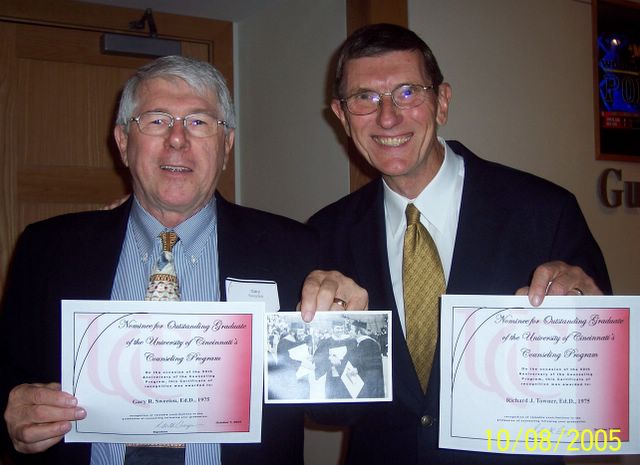
Dick Towner and Gary holding up a photo of them and Gary Penfield graduating with doctorates in August 1975. We are also holding up certificates showing that we were each nominated as "Graduates of the Decade" for our creative counseling work helping hurting people receive free, or Pro Bono, assistance.

Saturday, October 08, 2005
Over the Years The Ministry Grows
Last night was the Celebration of the U. C. Counseling Department 50th Anniversary. I have been thinking about what has happened since that day in August 1975 when Dick Towner, Gary Penfield and I received our Doctorate's in Counselor Education. I ministered at College Hill Presbyterian and I chose to pursue Counseling and Education rather than Clinical Psychology.
Both were options but I preferred to multiply the practical and biblically based insights from counseling to as many people as possible. This meant that I would not pursue a clinical career but rather do everything I could to equip individuals and churches with knowledge and skills that help people live the abundant life I had learned about in Sunday school and church.
Since then I have developed systems of teaching and training pastors and entire congregations in all seven levels of healing and growth.
1. Prevention: Such things as Pre-Marital Preparation, Preparing Parents
2. Personal Growth: Life Skills, Renewed Thinking, Personal Healing
3. Peer Support: Groups of Parents, Chronically Ill, Friendships and Fellowship
4. Para-Professional Counseling: Lay Care and Counsel
5. Professional Counseling-Entry Level: Master's Degree with little experience
6. Professional Counseling-Clinical: Masters or Doctors, advanced experience
7. Professional Counseling-In Patient and/or Residential Level: Medical and intensive training
About 70% to 80% of all helping and healing in society and the church is delivered through the first Three Levels. The greatest need by far is for more Prevention, Personal Growth and Peer Support. This would require many more leaders who can educate and train and less with Clinical skills and knowledge.
I just received CHPC's newsletter and they are still offering the classes today I started in 1976 after learning in my doctorate how to equip lay people. Many thousands of men, women and children there have learned how to listen, think and speak the truth in love. Keep up the good work College Hill.
Contact lcrank@chpc.org for information.
I am very pleased with my decision.
Last night was the Celebration of the U. C. Counseling Department 50th Anniversary. I have been thinking about what has happened since that day in August 1975 when Dick Towner, Gary Penfield and I received our Doctorate's in Counselor Education. I ministered at College Hill Presbyterian and I chose to pursue Counseling and Education rather than Clinical Psychology.
Both were options but I preferred to multiply the practical and biblically based insights from counseling to as many people as possible. This meant that I would not pursue a clinical career but rather do everything I could to equip individuals and churches with knowledge and skills that help people live the abundant life I had learned about in Sunday school and church.
Since then I have developed systems of teaching and training pastors and entire congregations in all seven levels of healing and growth.
1. Prevention: Such things as Pre-Marital Preparation, Preparing Parents
2. Personal Growth: Life Skills, Renewed Thinking, Personal Healing
3. Peer Support: Groups of Parents, Chronically Ill, Friendships and Fellowship
4. Para-Professional Counseling: Lay Care and Counsel
5. Professional Counseling-Entry Level: Master's Degree with little experience
6. Professional Counseling-Clinical: Masters or Doctors, advanced experience
7. Professional Counseling-In Patient and/or Residential Level: Medical and intensive training
About 70% to 80% of all helping and healing in society and the church is delivered through the first Three Levels. The greatest need by far is for more Prevention, Personal Growth and Peer Support. This would require many more leaders who can educate and train and less with Clinical skills and knowledge.
I just received CHPC's newsletter and they are still offering the classes today I started in 1976 after learning in my doctorate how to equip lay people. Many thousands of men, women and children there have learned how to listen, think and speak the truth in love. Keep up the good work College Hill.
Contact lcrank@chpc.org for information.
I am very pleased with my decision.
Subscribe to:
Posts (Atom)